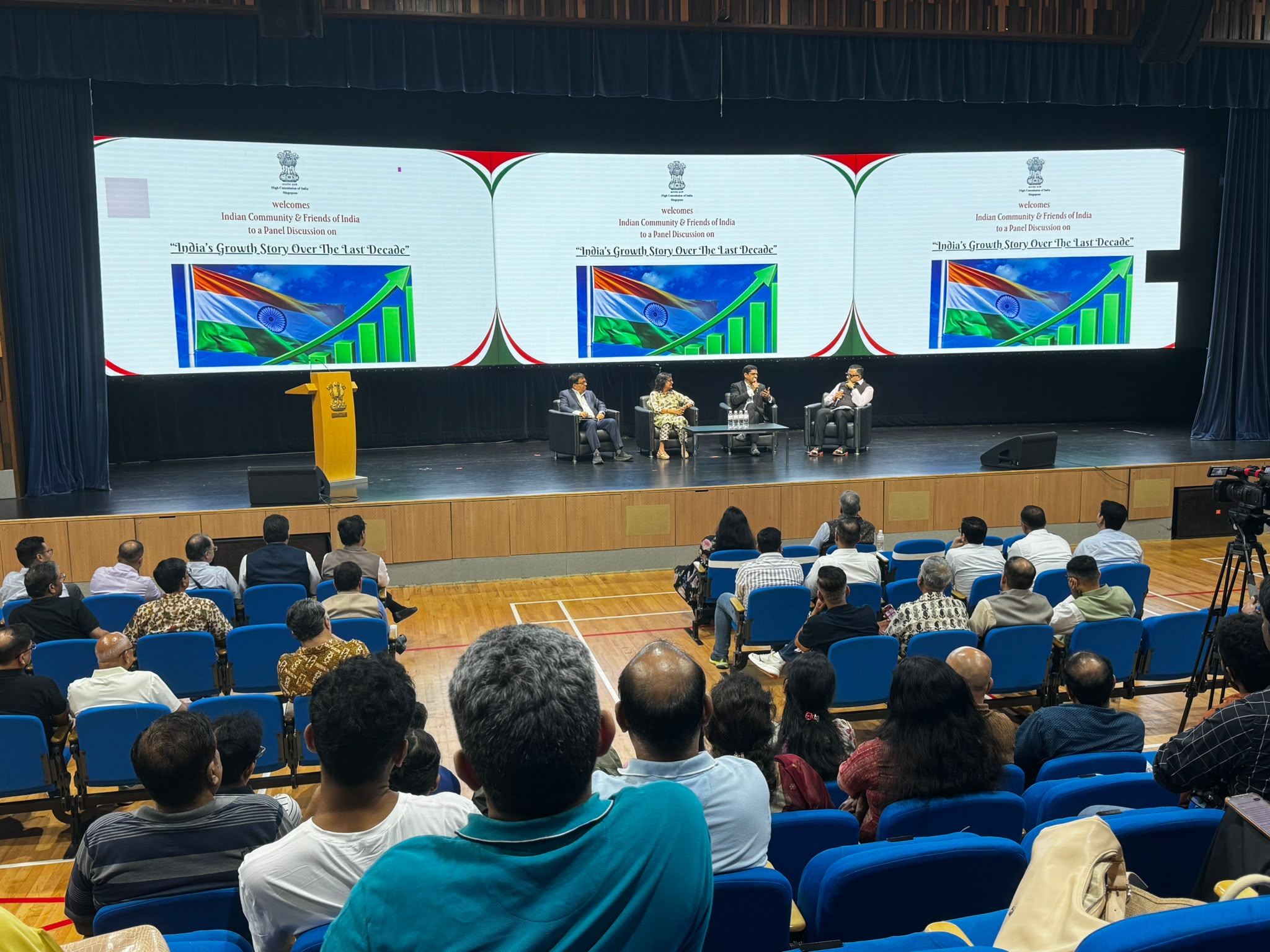
Audience at “India’s Growth Story Over the Last Decade” at GIIS SMART Campus. Photo supplied by the contributor.
India has the scale, talent, technology and ambition to become one of the world’s leading economic powers. Yet, when it comes to attracting international investors, one question remains: is the world seeing the India that is emerging, or is it still judging the country by the challenges it faces?
This was at the heart of “India’s Growth Story Over the Last Decade”, an event organised by the High Commission of India in Singapore on October 31, 2026, at the GIIS SMART Campus.
The discussion brought together voices from business, banking and education, including Mr Atul Temurnikar, Chairman of Global Schools Group; Mr Piyush Kumar Singh, CEO of Axis Bank Singapore; Mr K V Rajaram, CEO of ICICI Bank Singapore; and Ms Anuradha Shroff, former Chairperson of ICAI Singapore.
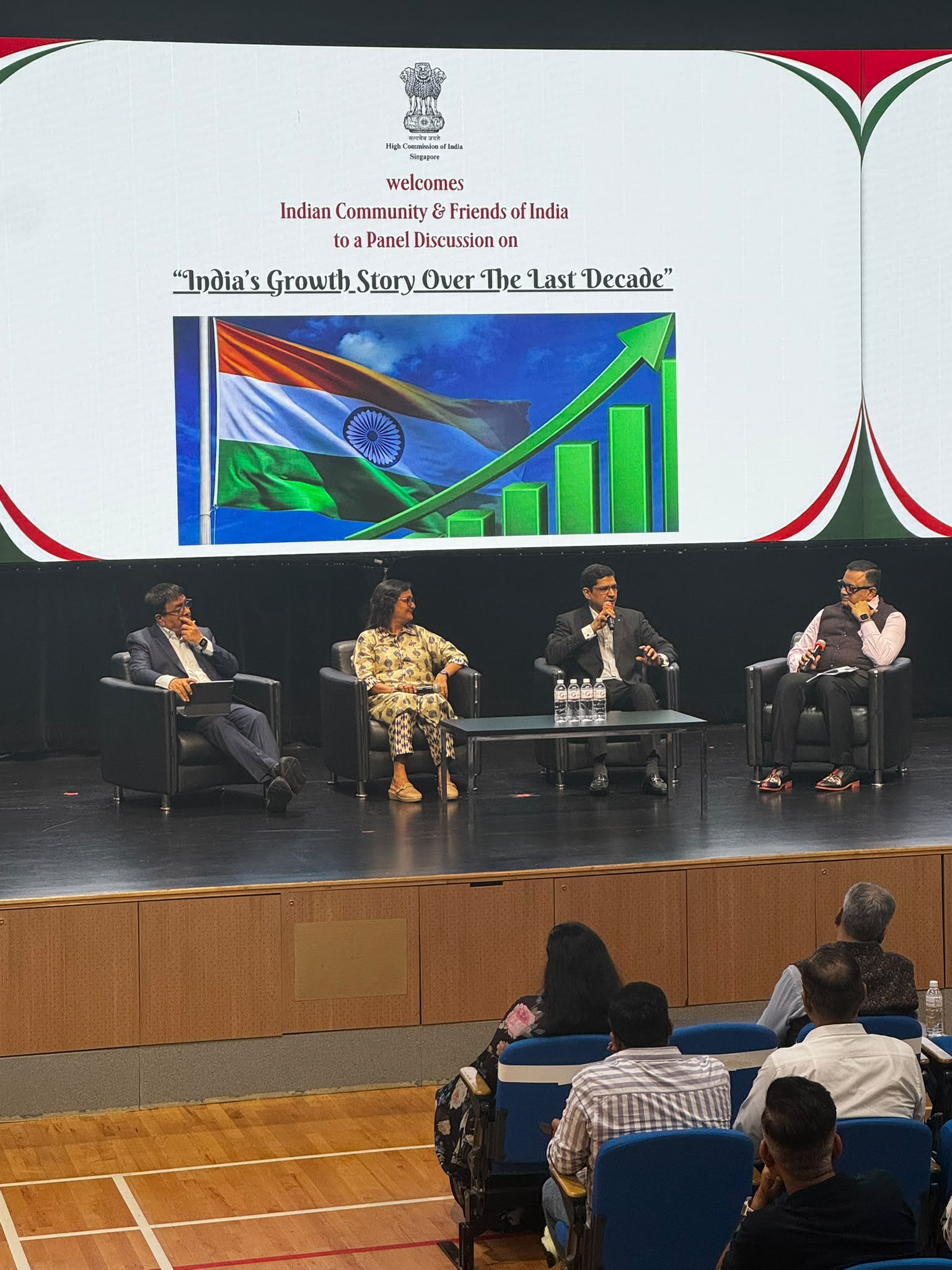
What emerged was a candid conversation about India’s achievements, but also what’s needed for the next decade.
Singapore is an important part of this story. It is one of India’s largest sources of foreign investment, contributing approximately US$19.8 billion in FDI in FY2025–26. The relationship has deep roots, built on trade, finance, technology and business connections. But how can India encourage more Singapore-based companies and investors to look beyond the opportunities they already know?
The answer, the discussion suggested, lies partly in making the business environment more predictable. India has a large consumer market, a growing technology ecosystem and considerable potential in manufacturing, infrastructure and financial services. Initiatives such as Make in India have helped put manufacturing at the centre of its growth ambitions. However, investors also want clarity on regulations, consistency in policies and confidence that what is promised will be implemented on the ground.
The perception of India as a complex market also needs attention. For businesses unfamiliar with the country, understanding its regulations, local partnerships and operating environment can be daunting. Building trust, therefore, is just as important as offering incentives.
There are opportunities to extend India’s manufacturing ambitions beyond large global corporations. Smaller companies supplying manufacturers such as Foxconn and Micron, for example, could become part of India’s expanding manufacturing and semiconductor supply chains. Singapore’s network of businesses and suppliers could help connect these companies to opportunities in India. Bringing these smaller players into the conversation could strengthen the ecosystem that global manufacturers need to operate successfully.
The discussion also touched on the weakening Indian rupee, an issue that resonates particularly with the NRI community. For Indians living overseas, currency movements are not just market indicators. They affect remittances, savings, investments, property purchases and financial commitments back home. Geopolitical uncertainty, higher energy prices, global dollar movements and foreign investment flows all influence the rupee. The larger concern is how economic uncertainty affects confidence among those who continue to have strong financial and personal ties with India.
Perhaps the more challenging part of the conversation was about India’s image abroad. There was an acknowledgement that the country’s recent international narrative has not always been favourable. Political developments, social concerns and internal challenges often dominate conversations, leaving less room for stories about India’s innovation, entrepreneurship, culture and achievements.
There is still limited exposure to the depth and diversity of Indian culture in many international circles. More cultural exchanges, business interactions, educational partnerships and people-to-people programmes could help change that. The Indian diaspora, with its connections and experience across markets, has an important role to play in telling a more complete story of the country.
Education offers another opportunity to build these connections. The discussion examined how the National Education Policy (NEP) 2020 could influence India’s position in the global education system. Its emphasis on multidisciplinary learning, entrepreneurship, vocational skills and multilingual education could help prepare students for a very different world of work.
Students need practical skills alongside academic knowledge, with greater exposure to technology, entrepreneurship and industry. Student exchange programmes between India and Singapore could further strengthen this relationship, allowing young people to experience different cultures and education systems while building international connections.
India’s digital payments journey was another area worth highlighting. The growth of UPI has transformed everyday transactions, demonstrating how technology can be deployed at an extraordinary scale. While fintech companies are making digital onboarding and financial services faster and more accessible, established banks bring regulatory experience, infrastructure and trust. Working together could create a stronger financial ecosystem.
India’s economic potential is not in question. The challenge is converting that potential into international confidence, investment and lasting partnerships.
For Singapore and India, the opportunity is considerable. But stronger ties will depend not only on investment announcements or government initiatives, but also on how easily businesses can work together, how confidently investors can enter the market and how well India communicates its strengths to the world.
Article and photographs supplied by the contributor.