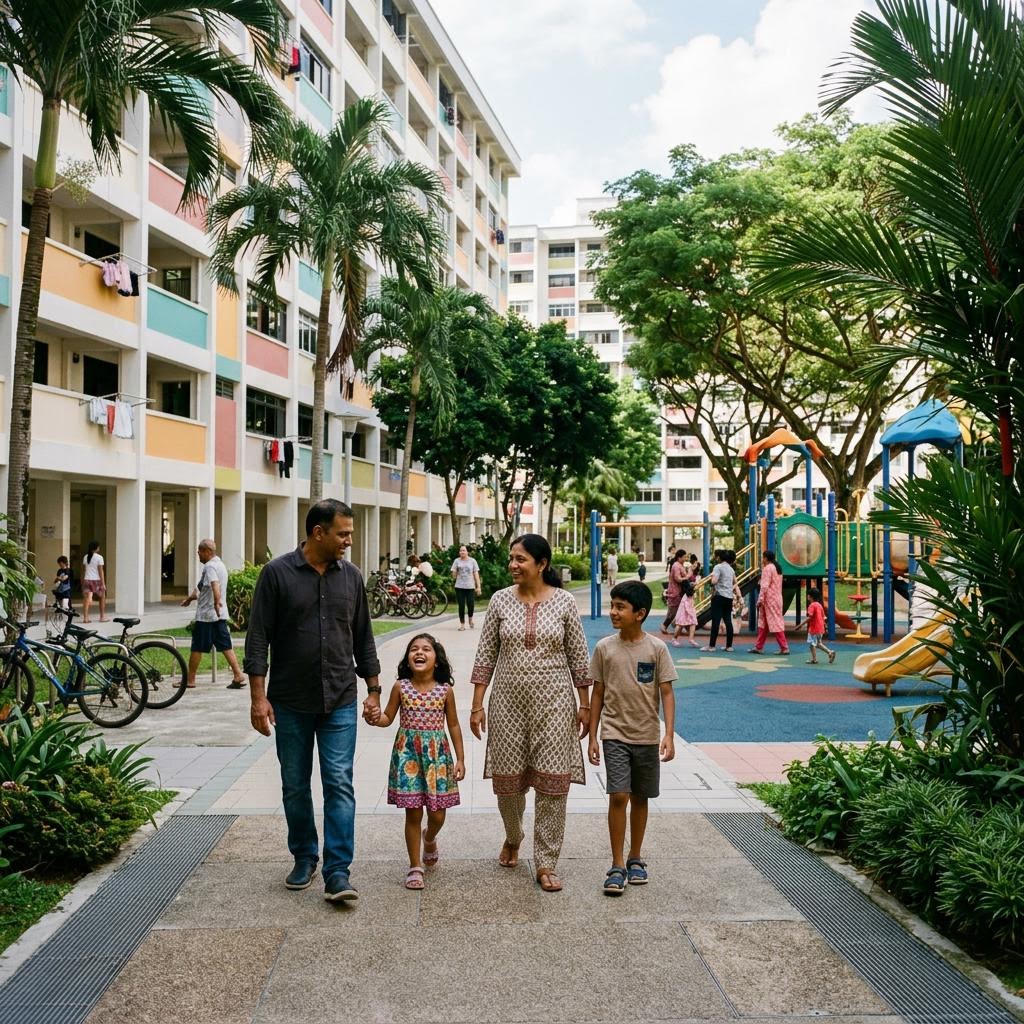
Finding a house in Singapore is not just about finding four walls, a good rent and a convenient MRT station. For an expat family moving to Singapore, the right home can make the difference between simply living in Singapore and actually feeling at home.
When you first arrive, it is tempting to focus on the obvious things: How much is the rent? Is the apartment close to work? Is there an MRT nearby? Is the condominium nice? But after the first few weeks, other questions start becoming important. Where will you buy familiar groceries? Will your children have other children to play with? Is there a suitable place of worship nearby? Can you cook the food your family is used to eating? Are there other expat families in the neighbourhood? How easy will it be for your spouse to build a social circle? And, perhaps most importantly, will you feel connected—or lonely?
1. Don’t just choose a house. Choose a neighbourhood.
One of the biggest mistakes newcomers make is choosing a home based only on the apartment itself. A beautiful three-bedroom apartment may look perfect online, but if it is far from your workplace, your children’s school, supermarkets, public transport and the community you want around you, everyday life can become unnecessarily difficult.
Before choosing a home, spend some time exploring the neighbourhood around the property. Walk around the area. Visit the nearest supermarket. Look at the restaurants. Check the MRT or bus connections. See what the streets feel like in the evening. If you have children, visit the nearby playgrounds. Think about what your life will look like on an ordinary Tuesday—not just how the apartment looks during a Saturday viewing.
2. For expat families, community can be more important than you initially realise.
Moving to another country is exciting, but homesickness can arrive quietly. It may happen when you are looking for the ingredients to make a familiar meal, during an important festival when your extended family is thousands of kilometres away, or when your children want friends who understand the same language, food or cultural references. Having a familiar community nearby can make the transition much easier.
This does not mean that you should live only around people from your home country. Singapore is wonderfully multicultural, and one of the advantages of living here is the opportunity to meet people from different backgrounds. But when you are new, having some familiarity around you can provide an important support system. Ask whether there are expat families, restaurants and grocery stores serving familiar food, places of worship, cultural associations, schools, activity groups or neighbourhood community groups nearby.
A useful trick is to look for speciality grocery stores, restaurants and cultural businesses. Several within a short distance can be a clue that international residents already live in or regularly visit the area.
3. Popular expat neighbourhoods are a starting point—but do not restrict yourself to them.
Areas in Singapore’s East are popular with many expat families because of the residential environment, schools, amenities, food options and connectivity. But international communities can be found across Singapore. Explore several neighbourhoods and compare the trade-offs, including rent, crowds, housing age, transport and proximity to the places that matter to your family.
The key is not to ask, “Which neighbourhood has the most people like us?” Instead ask, “Which neighbourhood gives my family the right combination of community, convenience, schools, transport and lifestyle?”
4. Ask the landlord about cooking before you commit.
Food is an important part of family life, and the ability to cook familiar meals can significantly affect your experience of living abroad. Before signing anything, ask explicitly about cooking arrangements and restrictions. Are there restrictions on frying, deep-frying, strong-smelling foods, gas, pressure cookers, air fryers or other appliances? Is cooking permitted if you are renting a room rather than the entire apartment? If something is important to you, do not rely on a verbal assurance. Get important agreements in writing.
5. If you have children, check the playground—not just the apartment.
When you view the property, take your children downstairs. Is there a well-maintained playground within walking distance? Are children actually using it? Is there a swimming pool, park, sheltered area for rainy days or enough open space to run around? If possible, visit after school, in the evening and on weekends. You will learn much more by watching how people use the neighbourhood than by looking at a property listing.
6. Check the amenities around the property.
Map out everyday essentials such as supermarkets, speciality grocery stores, pharmacies, clinics, ATMs, food courts, restaurants and bakeries. Check family needs including schools, preschools, tuition centres, playgrounds, parks, pools, sports facilities and children’s activities. Look for cultural associations, places of worship and community groups, as well as MRT stations, bus stops and realistic travel times to work and school.
Calculate the door-to-door commute rather than simply asking whether the apartment is “near an MRT”. A 10-minute walk can feel very different with a toddler, groceries and Singapore’s heat and rain.
7. Don’t fall in love with the apartment before checking the practical details.
Property photographs can be misleading. During the viewing, check the air-conditioning, water pressure, heaters, toilets, kitchen appliances, refrigerator, washing machine, oven, wardrobes, windows, locks, sockets, lights and fans. Look for mould, leaks, dampness, pests and general cleanliness. Open cupboards and taps, flush toilets and test the air-conditioning. If the home is furnished, inspect mattresses and furniture carefully.
8. Visit the property physically—especially if you are new to Singapore.
Do not rent purely from photographs, videos or WhatsApp conversations. Singapore’s Council for Estate Agencies advises prospective tenants not to make payments before viewing a property and recommends verifying the property agent’s identity. Speak to the agent, verify their registration, meet them, visit the property, confirm the landlord and understand the rental terms before paperwork or payment. Pressure to transfer money immediately is a major red flag.
9. Verify the property agent.
Anyone can put a property advertisement online. If you are dealing with an agent, verify the person through the CEA Public Register and check that the phone number being used matches the register. Do not rely only on a business card, WhatsApp profile, photograph of a registration card or registration number sent in a message. Scammers can impersonate legitimate agents.
10. Be careful about transferring money.
Do not pay simply because someone says the property needs to be “secured”. CEA advises against paying a deposit before verifying the listing and recommends making payments directly to the property owner using verifiable methods. Be especially careful with supposed government fees. IRAS has warned about fake requests for ABSD or stamp duty to secure rentals; ABSD is not payable on tenancy agreements.
11. Understand the Letter of Intent.
A Letter of Intent commonly sets out proposed rental terms before the formal Tenancy Agreement. If you are asked for an option fee, deposit or other payment, understand which document governs it, who receives it, and when it is refundable or forfeitable. A sensible sequence is: view the property, verify the agent and landlord, agree and document the terms, understand payment and refund conditions, use a verifiable payment channel, and then sign the Tenancy Agreement. An LOI alone does not prove a transaction is legitimate.
12. Read the Tenancy Agreement carefully.
Do not sign simply because you are told it is “the standard agreement”. Pay attention to monthly rent, payment methods, late-payment provisions, deposits and deductions, repairs, minor-repair limits, air-conditioning servicing, furniture and appliances, early termination, diplomatic clauses, renewal, permitted occupants, visitors, pets, smoking and cooking. If something matters to your family, make sure it is clearly documented.
13. Check whether you are renting an HDB flat or private property.
Rules and eligibility requirements can differ. Foreigners legally residing in Singapore may be eligible to rent HDB flats or bedrooms, subject to applicable conditions. Do not assume that every property advertised online is automatically available to you; check current HDB and CEA requirements before committing.
14. Understand stamp duty.
Stamp duty is payable on tenancy agreements, and the agreement should specify who is responsible for it. For a typical lease of four years or less where average annual rent exceeds S$1,000, IRAS currently states that lease duty is 0.4% of the total rent for the lease period. Make sure the agreement is properly stamped, retain the stamp certificate and verify the latest guidance with IRAS.
15. Take photographs before moving in.
On the day you receive the keys, photograph or video walls, floors, furniture, appliances, bathrooms, the kitchen, windows, doors, scratches, stains, mould, water marks and any existing damage. Make sure the condition report or inventory records these issues, and keep the evidence until your deposit has been returned.
16. Don’t forget the neighbourhood at night.
A property can look completely different at 11 a.m. and 9 p.m. Check traffic, nightlife, construction, lighting, weekend crowds and noise from roads, schools or playgrounds. If you are sensitive to noise, find out what the bedrooms face.
17. Think about your children’s daily life.
Ask what happens after school. Can your child walk or cycle safely? Are there other children, playgrounds, pools, lessons, tuition centres, sports activities or expat families with children of a similar age? Sometimes a slightly smaller home in a family-friendly neighbourhood is better than a larger home in an isolated location.
18. Don’t underestimate the importance of your spouse’s life.
When one person moves for work and the other is initially not working, the working spouse may quickly build an office network while the other spends much more time at home. Look for community and parents’ groups, adult activities, cultural associations, gyms, yoga studios, cafés and convenient public transport. A neighbourhood that gives one person a good commute but leaves another isolated may not be the right family choice.
19. Think about your commute—but calculate the whole journey.
Calculate home to MRT or bus, interchanges, the office and the return trip during peak hours. With children, include school drop-off and pickup. An apartment that is S$300 cheaper may not really be cheaper if it adds an hour to every day. Your time matters too.
20. Understand what your agent is—and isn’t—responsible for.
Clarify whom the agent represents, who pays any commission, what the agent handles during the transaction, whether they will assist during the tenancy and whom to contact when something breaks. CEA provides prescribed estate agency agreements that can help clarify services and commission arrangements. An agent’s formal role generally ends after signing and handover unless property-management services are separately agreed.
The most important lesson.
When you first arrive in Singapore, it is easy to think, “I just need to find a house.” But you are choosing much more: the neighbourhood where your children may grow up, the supermarket where you will buy groceries, the playground where they will make friends, the commute you will make every day and the community that may become your support system.
For expat families especially, finding a little familiarity can make a new country feel less unfamiliar. Look beyond square footage and find a neighbourhood where your family can build a life. Take your time. Verify the agent. Visit the property. Understand the agreement. Put important arrangements in writing. Never let pressure or fear of losing a property push you into transferring money before you have verified the transaction.
Singapore has a well-developed rental market and plenty of choices. The goal is not simply to find a house quickly. It is to find the right home—and start your Singapore story on the right foot.
If you’re looking for a trusted real estate agent, we can help point you in the right direction.
Ask usWhere to verify: This article is general editorial information, not legal, immigration, medical or financial advice. Requirements can change. Check the relevant Singapore government agency or a qualified professional for advice about your situation.