A familiar rhythm returns each year: the first prayers before a new beginning, the fragrance of flowers and incense, plates of modak, neighbourhood pandals filled with music, and crowds calling “Ganpati Bappa Morya” as Ganesha arrives.
In Singapore, Ganesh Puja begins on Monday, 14 September 2026, with Ganesh Pratishthapana at 9am as Maharashtra Mandal Singapore opens its five-day Ganeshotsav celebration at Farrer Park.
Ganesh Puja—most widely celebrated as Ganesh Chaturthi—is at once intimate and immense. A family may welcome a small clay murti into its home, while an entire city gathers around towering community idols. The forms differ, but the prayer at the centre is the same: may wisdom guide us, may obstacles be understood and overcome, and may a new beginning be auspicious.
The story begins with Parvati
The best-known account of Ganesha’s birth begins with Goddess Parvati. Wanting someone she could trust to guard her privacy while she bathed, she fashioned a boy from turmeric paste. In other tellings, the material is sandalwood paste or the earth and oils from her body. She breathed life into him and gave him one clear instruction: allow no one to enter until she said so.
When Lord Shiva returned, the boy at the door did not know him. Ganesha knew only the instruction given by his mother, so he refused Shiva entry.
A confrontation followed. Shiva, angered at being stopped, severed the boy’s head. When Parvati learned what had happened, grief became fury. She demanded that her son be restored.
Shiva agreed and sent his followers to bring back the head of the first living being they encountered. They returned with an elephant’s head. Shiva placed it upon the boy’s body, revived him and accepted him as his son.
The restored Ganesha received a blessing that explains his place in Hindu worship: he would be honoured before other deities and invoked at the beginning of important work. He became Vighnaharta, the remover of obstacles.
That is why Ganesha is remembered before a wedding, a journey, a new home, an examination, a business opening or a puja. The prayer is not merely for a problem-free life. It is a request for the judgement and strength needed to meet whatever comes.
Why an elephant head?
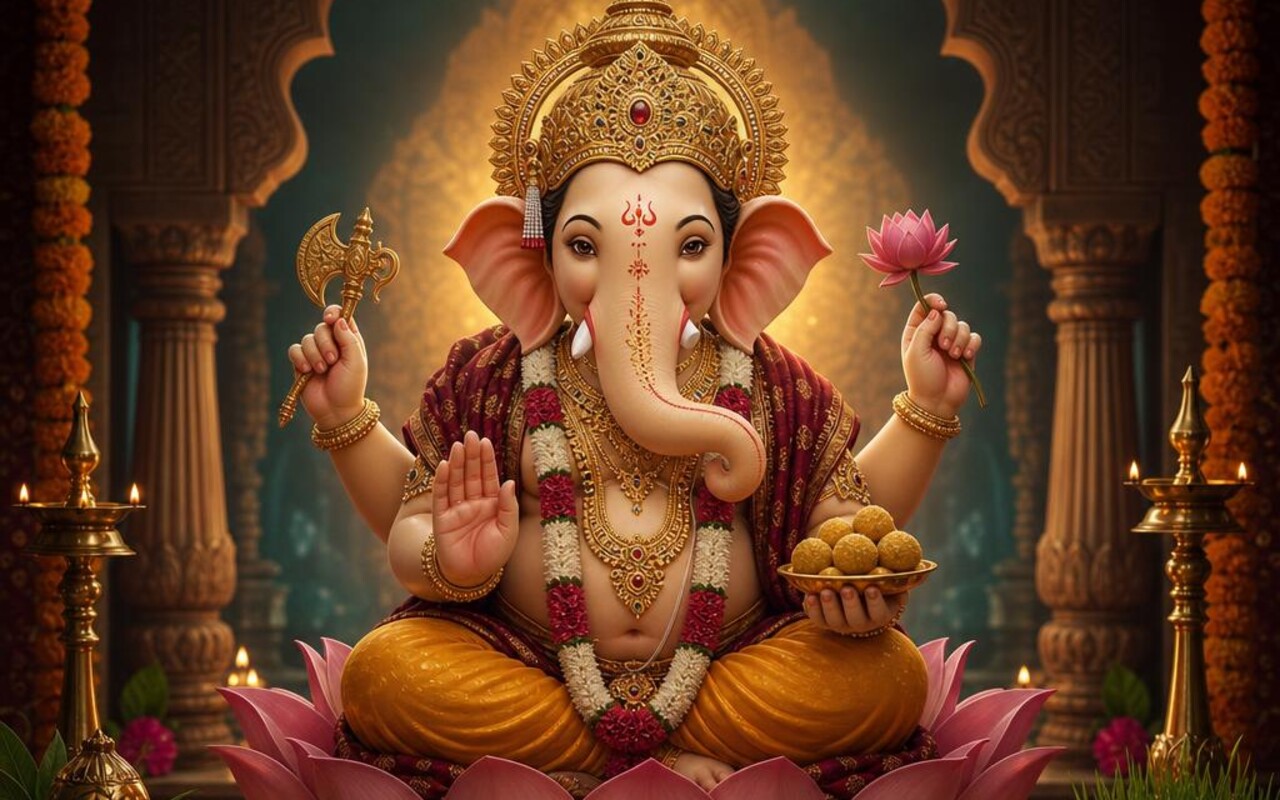
The elephant head makes Ganesha instantly recognisable, but its meaning goes beyond the story of his restoration. Generations of devotees have read a practical philosophy into his form:
- The large head asks us to think broadly and wisely.
- The wide ears remind us to listen before acting.
- The small eyes represent concentration and attention.
- The trunk combines strength with remarkable adaptability.
- The single tusk suggests sacrifice and the ability to move beyond imperfection.
- The mouse, his vehicle, shows that the smallest can carry the greatest—and that restless desire must be brought under control.
The image holds apparent opposites together: great and small, power and gentleness, intellect and devotion. Ganesha does not represent force alone. He represents force directed by wisdom.
The lesson of “You are my world”
Another beloved story places Ganesha beside his brother Kartikeya. Shiva and Parvati challenged the two brothers to travel around the world. Kartikeya immediately set off on his swift peacock.
Ganesha, whose mouse could never win a race of speed, walked around his parents three times instead. “You are my world,” he said.
He won not by moving faster but by seeing the question differently. The story explains why Ganesha is associated with intelligence and perspective: wisdom can find a path that strength and speed overlook.
What happens during Ganesh Puja?
Ganesh Chaturthi falls in the Hindu month of Bhadrapada, usually in August or September. The celebration may last for one and a half, three, five, seven or ten days, depending on family and community tradition.
Before the festival, homes are cleaned and pandals are built. Artisans create murtis ranging from small clay figures to monumental public installations. On the opening day, the murti is welcomed and ritually installed through pranapratishtha.
Devotees offer flowers, durva grass, coconut and sweets. Modak—sweet dumplings traditionally made with coconut and jaggery—is especially associated with Ganesha. Aarti, mantras, bhajans, family visits, cultural programmes and community meals continue through the festival.
The mood is devotional but not silent. Ganeshotsav can fill a neighbourhood with drums, theatre, music, children’s activities and public service. In many communities, blood-donation drives, food distribution, environmental campaigns and support for local causes sit alongside prayer.
Why does the festival end with visarjan?
On the final day, the murti is carried in procession for visarjan, traditionally an immersion in water. The farewell can be emotional because devotees have treated Ganesha as an honoured guest in the home or neighbourhood.
Yet the departure contains the festival’s central spiritual lesson. The physical form is temporary; the divine presence is not. Ganesha comes from the earth and returns to it, while the wisdom and devotion awakened during the celebration remain.
This is also why environmentally responsible celebrations increasingly favour natural clay murtis, non-toxic colours and managed immersion facilities. Returning Ganesha to nature should not harm the nature from which the murti came.
Why is Ganeshotsav so big?
Ganesha is loved across linguistic, regional and social boundaries. His role as the deity of beginnings makes the festival relevant to a child starting school, a family entering a new home, an artist beginning a performance and an entrepreneur opening a business.
The scale of today’s public Ganeshotsav also has a historical dimension. Household worship is ancient, but public community celebrations grew dramatically in Maharashtra in the late nineteenth century. Bal Gangadhar Tilak helped popularise sarvajanik, or public, Ganeshotsav as a space where people could gather, learn and build solidarity during British rule.
The pandal therefore became more than a shrine. It became a neighbourhood institution—a place for performance, debate, charity, organisation and belonging. That public tradition still explains much of the festival’s energy today.
Cinema, television and migration have carried its songs, visual language and processions far beyond the regions where the public festival became most prominent. Social media now lets families abroad follow the arrival and visarjan of neighbourhood Ganpatis in real time.
Where is Ganesh Chaturthi celebrated most prominently in India?
Ganesh Chaturthi is celebrated across India, but its character changes by region.
Maharashtra
Maharashtra is most strongly identified with large public Ganeshotsav celebrations. Mumbai, Pune and towns across the state host thousands of sarvajanik mandals. Mumbai’s famous pandals draw vast crowds, while Pune’s celebrations retain a strong connection to the festival’s public history, traditional processions and dhol-tasha ensembles.
Many Maharashtrian families also keep a Ganpati at home. The household and public forms exist side by side: one may be quiet and intimate, the other spectacular and communal.
Goa and the Konkan coast
In Goa and the wider Konkan region, Ganesh Chaturthi—often called Chavath—is deeply connected with extended-family gatherings and ancestral homes. Families travel to celebrate together, prepare regional foods and continue traditions passed through generations.
Karnataka
Karnataka marks Ganesha Chaturthi in homes, temples and public spaces, with major celebrations in Bengaluru and communities across the state. The observance is often paired with Gauri worship, linking the festival closely with household and family traditions.
Telangana and Andhra Pradesh
Hyderabad hosts some of India’s largest public installations and immersion processions. Across Telangana and Andhra Pradesh, neighbourhood associations, temples and families celebrate with murtis, cultural programmes and large community gatherings.
Tamil Nadu
In Tamil Nadu, Vinayagar Chaturthi honours Ganesha as Vinayagar or Pillaiyar. Temple worship, home puja and public installations are all part of the observance, accompanied by regional offerings such as kozhukattai.
Elsewhere in India
Ganesha is worshipped throughout India, including in Gujarat, Madhya Pradesh, Odisha, West Bengal, Rajasthan and northern states. The festival may be less dominant than another regional celebration, but temples, housing societies, families and cultural organisations still mark it with their own languages, foods and customs.
There is no single “correct” Ganeshotsav aesthetic. Its strength lies in the way a shared story can be expressed through Marathi dhol-tasha, Goan family ritual, South Indian temple traditions or a small home puja far from India.
Ganeshotsav in Singapore
That ability to travel with a community is visible in Singapore. In 2026, Maharashtra Mandal Singapore is presenting a five-day Ganeshotsav from Monday 14 September to Friday 18 September at the open field beside Holiday Inn, 2 Owen Road, Farrer Park, Singapore 218842.
The programme begins with Ganesh Pratishthapana at 9am on 14 September, followed by an evening prayer at 8pm. Morning and evening prayers continue through the week, with cultural performances scheduled daily at 7pm.
On Thursday 17 September, Atharvashirsha Pathan is scheduled for 8am, followed by the morning prayer at 9am. Dhol tasha will follow the evening prayer. On Friday 18 September, the programme lists morning prayer at 8am, J J Uttam at 5pm and Uttarpuja at 8pm.
For Maharashtrian families in Singapore, the familiar prayers, performances and dhol-tasha offer more than nostalgia. They give children a living encounter with a tradition they may otherwise know mainly through family stories and screens. For neighbours and friends from other backgrounds, the celebration opens a door into the meaning behind the music and colour.
The deeper message of Ganesh Puja
Ganesh Puja carries a sequence of ideas that remains useful beyond the festival:
- Before beginning something new, seek wisdom.
- When obstacles appear, do not lose courage.
- When a mistake is made, learn, repair and adapt.
- When success comes, remain humble.
- Remember that everything material is temporary.
Ganesha is loved not simply because devotees ask him to remove an obstacle. He also asks them to look at the obstacle differently: to listen, concentrate, adapt and understand what the difficulty may be teaching.
That is why Ganeshotsav can be both exuberant and reflective. The drums, flowers, sweets and processions bring a community together. The farewell sends each person home with a quieter question: what wisdom will we carry into the beginning that comes next?
Looking for more ideas beyond Singapore's famous attractions? Explore What's Hot in Singapore for upcoming events, new experiences, weekend activities and more ways to discover the city.
Where to verify: This article is general editorial information, not legal, immigration, medical or financial advice. Requirements can change. Check the relevant Singapore government agency or a qualified professional for advice about your situation.