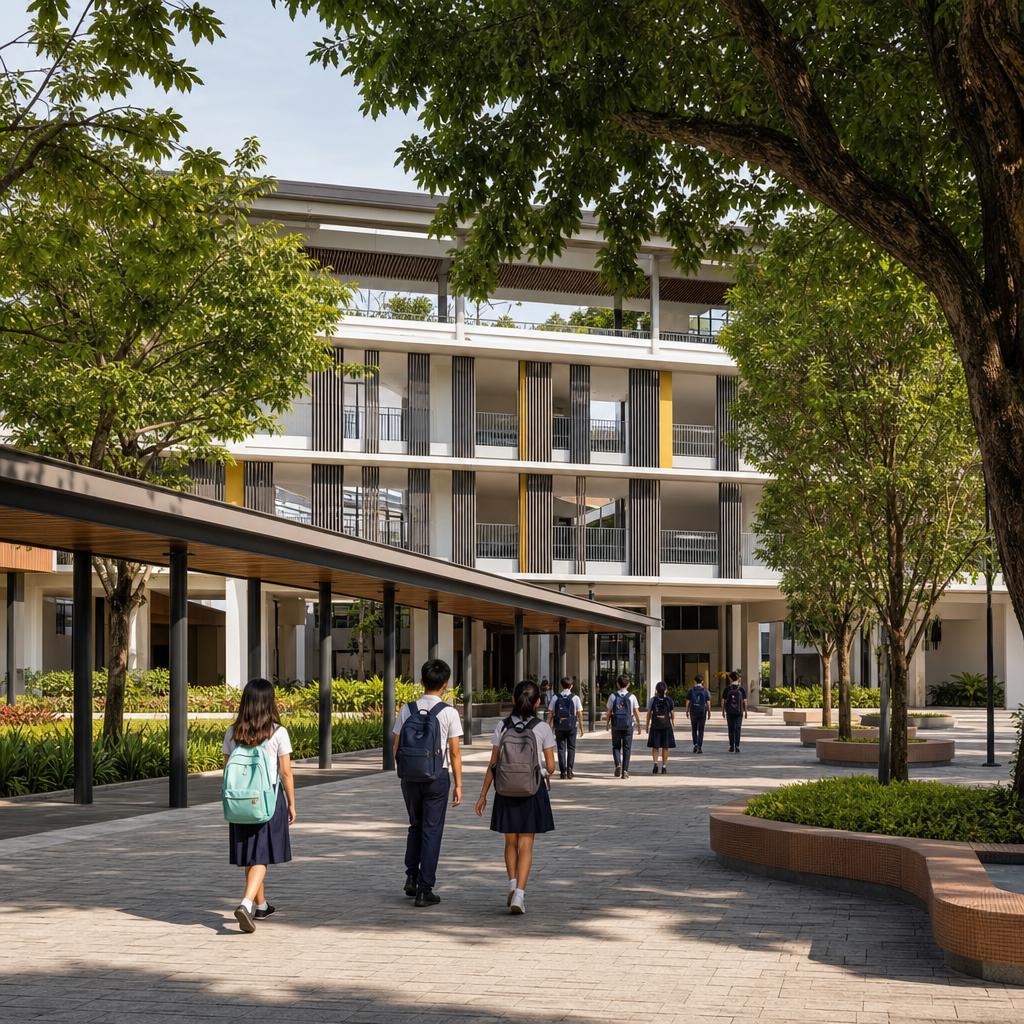
For a foreign family moving to Singapore with a child in secondary school or approaching the pre-university years, choosing a school starts with one question:
Which curriculum do you want your child to follow?
Singapore has a large international-school market, with schools offering IB, British/Cambridge, American, Australian and Indian/CBSE pathways. Current parent-interest data shows particularly strong demand around schools such as Dulwich, Canadian International School, Stamford American, UWCSEA, Tanglin Trust, Singapore American School and Australian International School. (Doris School)
The tables below are designed as a shortlist rather than a ranking of educational quality.
1. International Baccalaureate (IB)
The IB is one of the most internationally portable options.
For secondary students, the main pathways are:
IB Middle Years Programme (MYP) → IB Diploma Programme (IBDP)
The IBDP is normally the final two years before university.
Five IB schools worth putting on a foreign family's shortlist
| School | IB pathway | Typical secondary entry | Admission criteria | Admission timeline | Academic year |
|---|---|---|---|---|---|
| UWCSEA | IB across the secondary years → IBDP | Grades 6–12 | Application, school records, assessments and holistic review; availability is critical | Aug 2027: applications open 1 Sep 2026; main deadlines 2 Nov 2026 and 1 Feb 2027 | Aug–Jun |
| Canadian International School (CIS) | IB PYP → MYP → DP | Grades 6–12 | Application, previous school records and school assessment/placement; availability varies | Applications accepted ahead of intended entry; waitlists exist for some years | Aug–Jun |
| Stamford American International School | IB PYP/MYP/DP + American/AP options | Grades 6–12 | Application, academic records and age-appropriate assessment | Applications generally accepted throughout the year, subject to availability | Aug–Jun |
| XCL World Academy | IB PYP/MYP/DP + American elements | Secondary through Grade 12 | Application, supporting documents and required assessments | Rolling admissions; school says most completed applications take around 2–4 weeks | Aug–Jun |
| ISS International School | IB MYP/DP alongside its High School Diploma | Grades 6–12 | Academic records; English assessment; Grades 9–12 also Mathematics + CAT4 | Rolling enrolment subject to places | Aug–Jun |
UWCSEA is the clearest example of why parents should start early. For August 2027 entry, its application cycle opened on 1 September 2026, with the first deadline on 2 November 2026 and second-round deadlines in January/February 2027. Late offers are only made when unexpected places arise. (UWCSEA)
CIS confirms that its school year runs from August to June and that waiting lists exist for some year groups because of high demand. (Canadian International School)
Stamford is particularly interesting for families who are not completely committed to a pure IB pathway because it combines IB with American/AP options. Current parent-interest data places Stamford among Singapore's most-researched international schools. (Doris School)
XCL says its admissions process has five steps — application, fee, assessment, decision and enrolment — with most families completing the process in two to four weeks. (XCL World Academy)
ISS operates rolling enrolment, and for Grades 9–12 its placement process includes English, Mathematics and CAT4 assessments. (International School Singapore)
Who should consider IB?
IB can make particular sense if:
- Your family may move countries again
- You don't yet know where your child will attend university
- Your child enjoys research and independent learning
- You want a broadly international qualification
- Your child is already studying IB
But don't assume that IB is automatically easier to transfer into. Entering the IB Diploma at 16 or 17 from a completely different curriculum can be challenging.
2. British / Cambridge Curriculum
The British pathway is one of the largest international-school categories in Singapore.
A common route is:
British Curriculum → IGCSE → A Levels
Some schools offer an alternative senior pathway such as IB.
Five schools to investigate
| School | Secondary curriculum | Admission criteria | Timeline | Academic year |
|---|---|---|---|---|
| Dulwich College Singapore | British curriculum → IGCSE → senior pathways including IB | Academic records, age-appropriate assessment, English proficiency, teacher references where applicable, interview may be required | Applications up to 18 months ahead; applications by 31 Oct may receive early decision; majority decisions in March | Aug–Jun |
| Tanglin Trust School | English National Curriculum → IGCSE → A Levels or IB | School reports, age-appropriate assessment and English proficiency | For 2027/28, application deadline 15 Feb 2027 | Aug–Jun |
| Dover Court International School | British → IGCSE; IB/BTEC senior pathways | Previous school information, assessment and available places | Rolling applications; apply early; older-year availability depends on students leaving | Aug–Jun |
| North London Collegiate School Singapore | British → IGCSE → IB Diploma | Academic records, assessment and English proficiency | School-specific admissions cycle; early application advisable | Aug–Jun |
| Brighton College (Singapore) | British curriculum → IGCSE/senior pathways | Application, previous school records and assessment/interview | School-specific; availability dependent | Aug–Jun |
Dulwich is currently the most-researched international school in Singapore in the September 2026 parent-interest data, which makes it a reasonable inclusion when discussing parent demand rather than claiming educational superiority. (Doris School)
Dulwich's admissions process is particularly structured. The school assesses academic ability, English proficiency, previous school records, teacher recommendations and, where appropriate, interviews and diagnostic testing. Applications can be submitted no more than 18 months before the expected enrolment date, and the majority of decisions are made in March. (Dulwich College Singapore)
Tanglin is particularly interesting for secondary students because it offers both A Levels and IB Diploma in Sixth Form. It is also currently oversubscribed and operates an applicant pool rather than simply a chronological waiting list. For 2027/28, applications are due by 15 February 2027. (TTS)
Dover Court says that older-year places generally arise when existing students leave, while Years 7 and 8 have additional capacity from August 2026. It specifically recommends applying early. (Nord Anglia Education)
Who should consider British/Cambridge?
This pathway may suit families who:
- Already follow a British curriculum
- Are considering UK universities
- Prefer subject-specific IGCSEs
- Want A Levels
- Want the option of moving between British international schools internationally
3. American Curriculum
The American pathway generally runs:
Middle School → High School → High School Diploma
Some schools add Advanced Placement (AP) courses.
AP can allow students to take university-level courses during high school.
Five schools/options worth investigating
| School | Curriculum | Admission criteria | Timeline | Academic year |
|---|---|---|---|---|
| Singapore American School (SAS) | American curriculum + AP | Application, school records, required documents; placement depends on space and priority | Applications can be made up to 2 years in advance; rolling admissions | Aug–Jun |
| Stamford American | American + IB + AP | Application, records and assessment | Rolling/availability based | Aug–Jun |
| XCL World Academy | IB + American elements | Application, records and assessment | Generally, 2–4 weeks after completed application | Aug–Jun |
| ISS International School | IB + High School Diploma | Records + placement testing; G9–12 English, Maths and CAT4 | Rolling | Aug–Jun |
| Middleton International School | International/American-influenced pathway | Application, records and placement assessment | School-specific/availability based | Aug–Jun |
SAS deserves particular attention for families specifically seeking a traditional American pathway.
Its application system accepts applications up to two years before the intended entry date. The school says completing the application early can improve the likelihood of admission. (Singapore American School)
For 2026/27, SAS's published availability shows how quickly senior-year places can become constrained: Grade 7 and 8 were forming wait pools, while Grades 9–11 required families to inquire about availability and Grade 12 was no longer accepting applications for that school year. (Singapore American School)
That is an important lesson for parents:
Don't assume that international schools have unlimited places simply because they are private.
4. Australian Curriculum
The Australian option is smaller than the IB or British market in Singapore, but it can be very useful for families who have an Australia-oriented education pathway.
Schools to investigate
There are fewer major Australian-curriculum international schools in Singapore, so I would not artificially create a “top five” ranking where there aren't five comparably prominent options.
| School | Australian pathway | Admission criteria | Timeline | Academic year |
|---|---|---|---|---|
| Australian International School (AIS) | Australian Curriculum + IGCSE + HSC / IB DP | Application, school records and year-level placement; programme-specific entry requirements | Four main intakes: Jan, Apr, Jul, Oct, plus year-round enrolment | International calendar |
| Middleton International School | International curriculum with Australian/other influences depending on programme | Application + school records/assessment | Generally flexible/availability based | Aug–Jun |
| Australian International School-linked pathways | Australian/IB options | School-specific | Contact admissions | School-specific |
AIS is the major obvious option for a family specifically seeking an Australian pathway.
AIS's current structure is quite useful for secondary students:
Years 6–8: Australian Curriculum
Years 9–10: Australian Curriculum + Cambridge IGCSE
Years 11–12: HSC or IB Diploma. (AIS Singapore)
AIS also has an unusually flexible admissions calendar, with four main intakes — January, April, July and October — as well as year-round enrolment, although IGCSE, HSC and IB Diploma entry have restrictions. (AIS Singapore)
That flexibility can be particularly useful for families relocating to Singapore at different times of the year.
5. Indian / CBSE Curriculum
For Indian families, particularly those who may eventually return to India, CBSE can be an important alternative to IB or Cambridge.
The major advantage is continuity.
A student already studying CBSE in India does not necessarily need to completely change educational systems after moving to Singapore.
Schools’ worth investigating
| School | Indian/international pathway | Admission criteria | Timeline | Academic year |
|---|---|---|---|---|
| Global Indian International School (GIIS) | CBSE + international programmes | Application, previous academic records and school assessment where applicable | Applications generally accepted throughout the year subject to availability | Apr–Mar / programme dependent |
| NPS International School | CBSE + IB + Cambridge/British options | Application, previous school reports and assessment/placement | School-specific; availability based | Aug–Jun |
| DPS International School Singapore | CBSE + international pathways | Application, academic records and assessment | School-specific | Apr–Mar |
| GIIS SMART Campus | CBSE + IB/other pathways depending on year | Application, academic records and assessment | Rolling/availability based | Programme dependent |
| NPS International / Indian pathway | CBSE with international options | Application + records/assessment | Availability based | Aug–Jun |
FAQs
There are three broad models.
1. Annual admissions cycle
Example:
UWCSEA
Applications for August 2027 opened in September 2026, with defined deadlines and offer rounds. (UWCSEA)
2. Fixed annual deadline
Example:
Tanglin
For 2027/28, the application deadline is 15 February 2027. (TTS)
3. Rolling admissions
Examples include:
SAS, ISS and AIS, although places remain subject to availability and some programmes have specific entry restrictions. (Singapore American School)
What does an international school usually ask for?
Although every school differs, foreign families should prepare:
- Child's passport
- Birth certificate
- Current school report
- Previous school reports
- Examination results
- Current curriculum
- Teacher reference/recommendation where required
- English-language information
- Learning-support information, if applicable
- Immigration/residency information
For a secondary-school applicant, academic history becomes increasingly important.
A child applying for Year 10 or Grade 10 will generally face more scrutiny than a young child entering an early primary year.
What about English proficiency?
This can be one of the biggest hurdles for an older child.
Many international schools teach primarily in English.
Some provide EAL/English-language support, but highly selective schools may expect a student to already have sufficient English to access the curriculum.
Dulwich, for example, requires applicants to demonstrate the English proficiency needed to participate effectively in its academic programme. (Dulwich College Singapore)
For a 12-year-old moving from a non-English-medium school, this may be manageable.
For a 16-year-old entering IGCSE or IB Diploma, it becomes much more significant.
What if my child is already 15 or 16?
This is where parents need to be particularly careful.
If your child is approaching:
- IGCSE
- GCSE
- IB Diploma
- A Levels
- AP
- HSC
- CBSE Class 11/12
do not choose a school solely based on its reputation.
First ask:
Can my child enter this programme at this stage?
Then ask:
Will the school allow the subjects my child needs for university?
And finally:
Will the school accept my child's existing qualifications and curriculum?
For example, moving into an IB Diploma without having completed the preceding curriculum can be substantially different from entering an international school in Grade 7.
How early should a foreign family apply?
For a secondary-school child, my practical recommendation would be:
12–18 months before
Shortlist schools and curriculum.
9–12 months before
Submit applications to the most competitive schools.
6–9 months before
Complete assessments and interviews.
3–6 months before
Secure the place, pay deposits and arrange immigration/transport.
If moving urgently
Apply immediately to schools with rolling admissions and simultaneously contact schools with annual admission cycles.
Don't wait for your Singapore employment pass or dependent pass to be physically issued before beginning school research. You can start discussions with admissions teams much earlier.
One more thing: the school year matters
This is easy to overlook.
Most international schools operate approximately:
August → June
whereas Singapore government schools generally operate:
January → November
Even within international schools, there are differences.
CIS's 2026/27 year, for example, runs from 12 August 2026 to 17 June 2027. (Canadian International School)
ISS begins its 2026/27 academic year on 3 August 2026 and ends it on 10 June 2027. (International School Singapore)
AIS offers multiple entry points throughout the year. (AIS Singapore)
So the timing of your relocation can materially affect which schools are practical.
Sources and further reading
Admissions dates, places, assessments and curricula can change. Check each school’s current guidance before applying.
- Doris School — Singapore parent-interest data
- UWCSEA — Admissions timelines
- Canadian International School — Admissions
- XCL World Academy — Admissions process
- ISS International School — Admissions
- ISS International School — Academic calendar
- Dulwich College Singapore — Admissions overview
- Tanglin Trust School — Admissions
- Dover Court International School — Admissions
- Singapore American School — Application process
- Singapore American School — Space availability
- Australian International School — Admissions
- Australian International School — Contact
Where to verify: This article is general editorial information, not legal, immigration, medical or financial advice. Requirements can change. Check the relevant Singapore government agency or a qualified professional for advice about your situation.