1. What is the Cambridge English test requirement for Primary students?
Primary AEIS applicants have an additional English-language requirement.
Depending on the child’s circumstances and applicable level, the relevant Cambridge English qualification is part of the eligibility process.
The Cambridge English examinations commonly associated with this requirement include:
- A2 Key for Schools
- B1 Preliminary for Schools
Cambridge describes A2 Key for Schools as demonstrating basic English ability, while B1 Preliminary for Schools represents an intermediate level.
This is separate from the actual AEIS Mathematics examination.
So parents should think of the process as:
Cambridge English qualification → AEIS Primary application → AEIS Mathematics test
rather than assuming that the AEIS test itself will assess everything.
2. What does the AEIS Primary test cover?
This is another area where online information can be confusing.
For AEIS-Primary, the actual AEIS test is Mathematics.
SEAB says students should be familiar with the Mathematics topics taught in Singapore mainstream schools for the level preceding the level they are applying for.
Example
If a child is applying for admission to Primary 3, they should be familiar with the relevant Primary 2 Mathematics content.
The same principle applies to the other levels.
3. What does the Primary Mathematics test look like?
The test format depends on the level.
Primary 2/3
The Mathematics test has two parts:
Part 1
- 29 multiple-choice questions
- 25 minutes
Part 2
- 17 short-answer questions
- 40 minutes
Calculators are not allowed.
Primary 4/5
The Mathematics test also has two parts.
Part 1
- 30 multiple-choice questions
- 35 minutes
Part 2
- 8 short-answer questions
- 6 open-ended questions
- 50 minutes
Again, calculators are not allowed.
For the short-answer and open-ended questions, students need to show their working, not simply provide the final answer.
4. What about Secondary students?
This is where AEIS becomes significantly different.
For Secondary 1, Secondary 2 and Secondary 3, students sit for:
- English
- Mathematics
The English examination is substantial.
It tests:
- Writing
- Reading comprehension
- Comprehension cloze
- Vocabulary
- Grammar
The Mathematics examination includes multiple-choice, short-answer and open-ended questions.
5. What does the AEIS Secondary English test include?
The English examination lasts 2 hours and 10 minutes.
It has two major components.
Part 1: Writing
Students choose one topic and write a composition.
The expected length depends on the level:
- Secondary 1: 200–300 words
- Secondary 2: 250–350 words
- Secondary 3: 300–400 words
The number of writing topics also differs by level.
Part 2: Comprehension and language use
There are 50 compulsory multiple-choice questions covering:
- Reading comprehension
- Comprehension cloze
- Vocabulary
- Grammar
The comprehension section is based on two passages, while the cloze section is based on two passages.
This means secondary applicants should not prepare only by doing Mathematics papers.
English preparation is equally important.
6. How do you prepare for the AEIS Secondary Mathematics test?
The Mathematics examination consists of two parts.
Part 1
- 34 multiple-choice questions
- 30 minutes
Part 2
- 20 short-answer questions
- 10–15 open-ended questions
- 1 hour 45 minutes
Calculators are not allowed.
Students must also show their working for short-answer and open-ended questions.
7. What syllabus should students study?
This is probably the most important preparation question.
Don’t simply buy a generic “AEIS book” and start doing random questions.
SEAB specifically says students should become familiar with the MOE mainstream-school syllabus for the level immediately preceding the level they are applying for.
For Primary
If applying for Primary 3, study the relevant Primary 2 Mathematics content.
For Secondary
If applying for Secondary 2, study the relevant Secondary 1 English and Mathematics content.
If applying for Secondary 3, study Secondary 2 English and Mathematics content.
This is an important distinction.
The test is not simply asking, “What did my child study in their current school?”
It is asking whether the child has the necessary foundation corresponding to Singapore’s curriculum.
8. Where can parents get the syllabus?
Start with MOE’s official curriculum and syllabus information, rather than relying entirely on commercial AEIS websites.
SEAB specifically directs candidates to the MOE primary-school syllabus and relevant secondary or O-Level syllabus information when preparing for AEIS.
- MOE — Singapore school curriculum and syllabus information
- SEAB — AEIS test details and preparation requirements
9. How many months should you prepare?
There is no official MOE rule saying that students must prepare for a certain number of months.
The right amount of preparation depends on the student’s existing English, Mathematics and familiarity with Singapore’s curriculum.
As a practical planning guide:
6–12 months before
Start if the child is coming from a different curriculum or has significant gaps.
3–6 months before
A structured preparation programme can be useful for many students.
1–3 months before
Focus on:
- Timed papers
- Weak areas
- Writing
- Speed
- Exam technique
Final 2–3 weeks
Don’t try to teach the entire syllabus again.
Focus on:
- Practice
- Accuracy
- Time management
- Reviewing mistakes
- Sleep and routine
10. What happens on the day of the AEIS test?
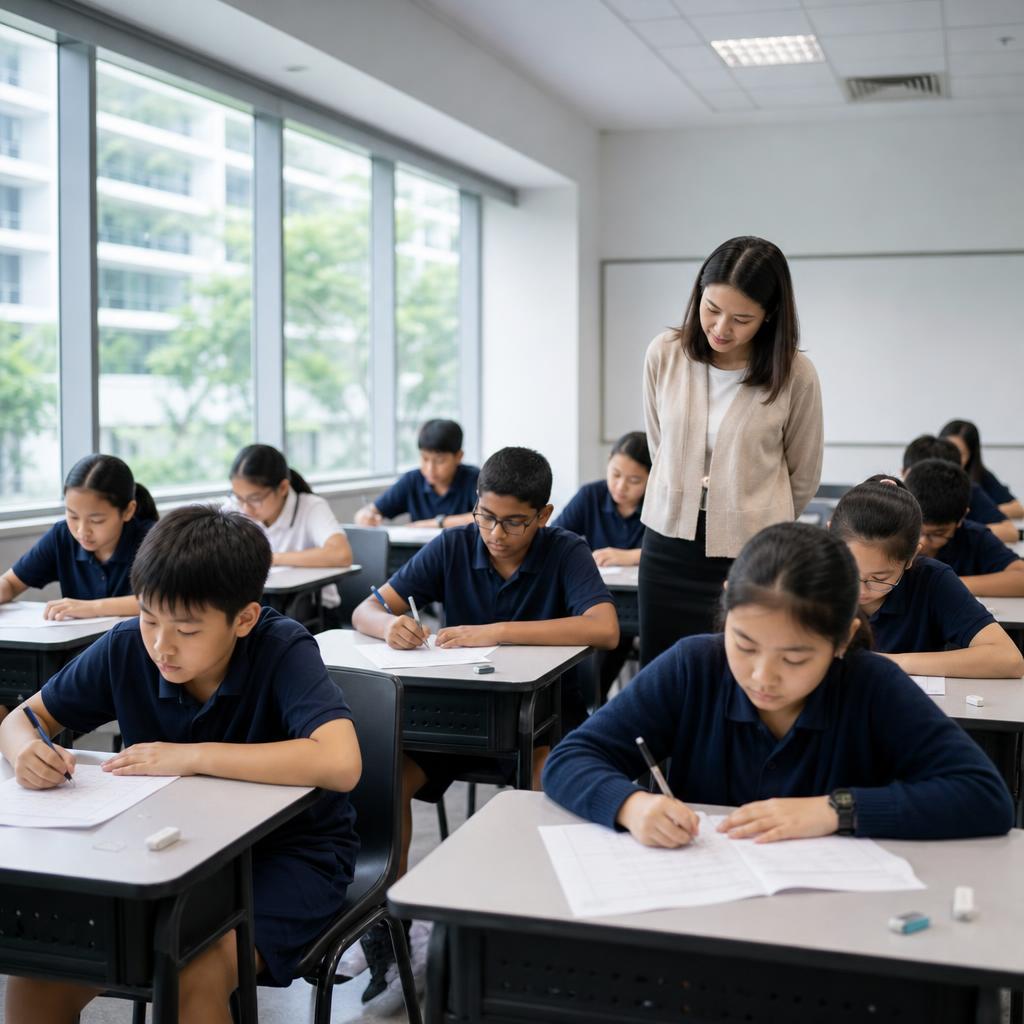
The test venue is provided on the student’s Entry Proof.
SEAB says successful applicants should arrive at least 45 minutes before the test and be seated at their assigned desks at least 15 minutes before the examination begins.
Candidates need the required identification documents, including:
- A copy of the passport biodata page
- A copy of the SEAB Entry Proof
The Entry Proof is therefore something parents should check carefully before examination day.
11. Do students receive an AEIS “score”?
This is another point parents should understand.
For AEIS-Secondary, SEAB states that there will not be a release of test results in the usual sense. Instead, applicants check their AEIS outcome through the relevant MOE system during the specified outcome period.
So parents should not necessarily expect a report saying:
- Mathematics: 82%
- English: 76%
- Overall: 79%
The important outcome is whether the applicant receives a school offer.
12. Does passing AEIS guarantee a school?
No.
Taking or passing the AEIS test does not guarantee admission to a particular school.
For successful applicants, school placement depends on factors including:
- Test performance
- Available vacancies
- Declared residential area
This means AEIS is better understood as an admissions exercise, rather than an examination where a child simply achieves a pass mark and then chooses any school.
13. Can parents choose the school?
Parents should not approach AEIS with the assumption that passing the examination gives them a free choice of school.
MOE’s school placement process considers available vacancies and the student’s declared residential area.
Therefore, before registering, families should think carefully about where they expect to live in Singapore.
Your residential address can become relevant to the eventual school placement process.
14. What happens after a successful application?
Successful applicants receive information about their school offer and reporting arrangements.
The child then reports to the allocated school according to the instructions provided.
For the 2026 AEIS cycle, successful students are seeking admission for the 2027 school year.
15. What if my child doesn’t get a place?
Not getting a place through AEIS does not necessarily mean that the family has no other education options.
Depending on the child’s circumstances, families can explore:
- S-AEIS, where the child meets its eligibility requirements
- International schools
- Other MOE admission routes where applicable
- Specialised schools or programmes with their own admissions requirements
However, parents should check eligibility carefully because S-AEIS covers fewer levels than AEIS.
S-AEIS is currently for Primary 2–4 and Secondary 1–2.
16. Can a student take AEIS from overseas?
This is particularly important for families moving to Singapore.
The examination itself is conducted in Singapore.
MOE states that it will not issue permits for applicants to enter Singapore specifically to sit for the AEIS or S-AEIS tests.
Families applying from overseas therefore need to make their own arrangements to be able to enter Singapore legally for the examination.
Parents should check the latest requirements with Singapore’s Immigration and Checkpoints Authority before making travel arrangements.
17. Where can you get AEIS practice papers and preparation material?
There are several routes.
1. Start with official SEAB material
This should be your first stop.
SEAB publishes the official test structure and explains the types of questions, timing and requirements.
The objective should be to understand:
- Number of questions
- Timing
- Question types
- Working requirements
- English writing expectations
- Mathematics format
2. Use Cambridge’s official preparation material for the English requirement
For Primary students who need a Cambridge English qualification, Cambridge itself provides free preparation resources.
For example, Cambridge provides:
- Sample tests
- Answer keys
- Practice activities
- Vocabulary resources
- Writing practice
- Reading practice
- Listening practice
These are particularly useful because they come directly from the organisation that develops the Cambridge English examinations.
3. Commercial AEIS preparation books
There are also many commercial AEIS books and practice papers available in Singapore.
These can be useful for additional practice, particularly because students need exposure to the style and time pressure of the examination.
However, parents should check:
- Which AEIS level the book is designed for
- Whether it reflects the current test format
- Whether it covers Singapore’s curriculum
- Whether answers and explanations are included
- Whether the publication is current
Don’t assume that a book labelled “AEIS” automatically reflects the latest test format.
4. AEIS tuition and preparation centres
Some families choose structured preparation classes.
This can be useful when:
- The child is unfamiliar with the Singapore curriculum
- English is not their strongest language
- The student struggles with time management
- Parents cannot teach the Singapore syllabus themselves
- The family needs a structured preparation timetable
But tuition is not an official requirement for AEIS.
A child does not have to attend an AEIS preparation centre to register for or sit the examination.
The key is familiarity with the required curriculum and test format.
Once those questions are answered, preparation becomes much more straightforward.
For Primary students, the focus is the relevant Mathematics syllabus plus meeting the Cambridge English requirement.
For Secondary students, preparation needs to cover both English and Mathematics, with particular attention to English writing, comprehension, grammar and vocabulary.
And for both age groups, students need to become comfortable with Singapore-style Mathematics questions, showing their working and working accurately under time pressure.
Most importantly, parents should use SEAB and MOE as the final authority for dates, eligibility, registration requirements and test format, because AEIS rules and timelines can change from year to year.
Sources and further reading
Entry rules, prices, schedules and opening hours can change. Check current official guidance before booking or travelling.
Where to verify: This article is general editorial information, not legal, immigration, medical or financial advice. Requirements can change. Check the relevant Singapore government agency or a qualified professional for advice about your situation.