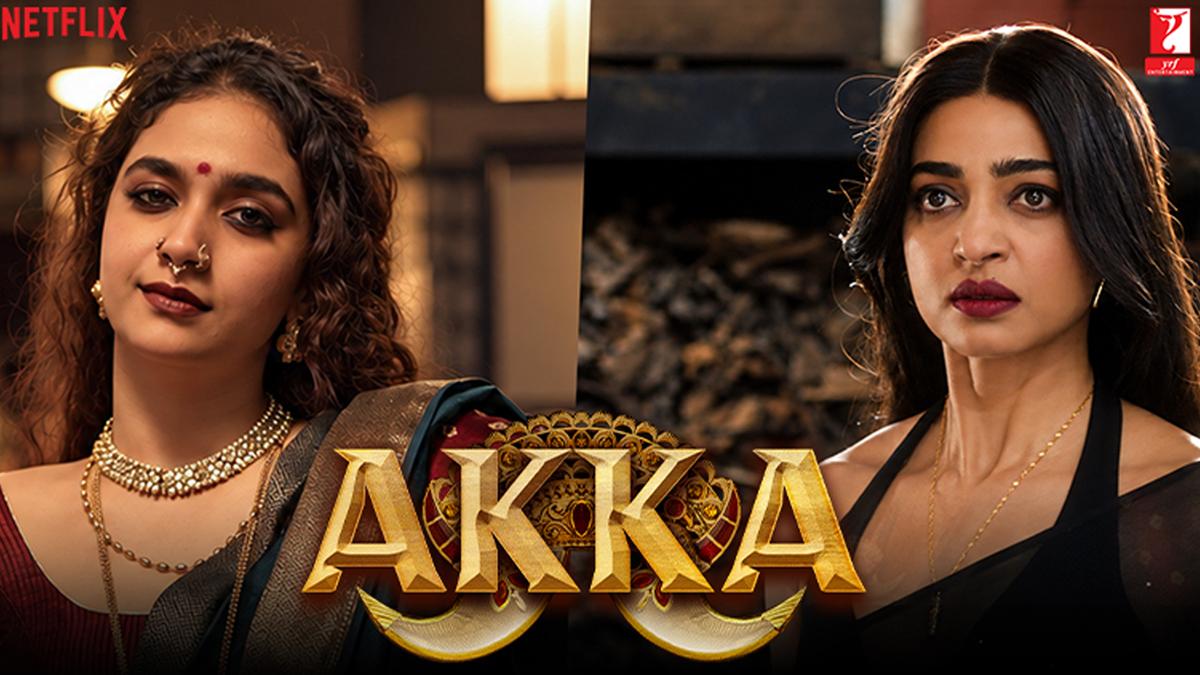
Some stories deserve attention simply because they dare to explore a world that mainstream cinema rarely touches. Akka, streaming on Netflix, is one such series. It begins with a fictional setting and an intriguing concept: a matriarchal kingdom where women hold power, three female rulers govern different territories, and the birth of a girl child is celebrated because the lineage and succession pass through the female line.
Set in the fictional kingdom of Pernuru, the story takes us through different timelines, beginning in 1947 and eventually moving to 1985, when Bhavani (Keerthy Suresh) is at the centre of the kingdom's power structure. Pernuru is believed to have been governed by women for nearly 800 years, following a history in which the women took charge after the men of the kingdom perished in war.
The idea of exploring such a society is perhaps the strongest aspect of Akka. While Pernuru is fictional, the concept does bring to mind matrilineal communities that have existed in different parts of India, including the Khasi and Garo communities of Meghalaya and the Nair community of Kerala. In these societies, lineage and inheritance traditionally follow the mother's side, although their social structures are very different from the fictional matriarchal kingdom portrayed here. The series may not be a historical account, but it certainly opens up an interesting conversation about cultures and traditions that are often overlooked.
The story initially builds its world quite well. You begin to understand the power structures, relationships, traditions and unwritten rules that govern this society. However, the narrative starts losing some of its grip when Rudra (Radhika Apte), an outsider connected to Mumbai gangster Shankar Anna (Mahesh Manjrekar), enters the picture. She arrives with an agenda to challenge Bhavani's authority and take control of Pernuru.
The story was progressing rather well until Rudra character was introduced. Her motivations and the way she eventually dismantle an entire empire feel somewhat forced. What makes it more disappointing is how quickly the destruction unfolds. An establishment that has seemingly survived generations of traditions, power struggles and social structures is brought down rather easily.
The redemption arc, too, arrives rather late, almost entirely in the final episode. By then, the circumstances have changed so drastically that the eventual outcome does not feel entirely convincing. The resolution could have been more meaningful had the story spent more time developing the characters and the reasons behind their choices.
There are also several loose ends that leave you wondering about the relationships between characters. At times, it becomes difficult to establish who is whose brother, son, lover or relative. These connections are important to understanding the power dynamics within the story, and a little more clarity would have helped.
Yet, despite these shortcomings, there is something admirable about the ambition behind Akka.
The performances are undoubtedly one of its biggest strengths. The cast does a commendable job of bringing this unusual world to life. Keerthy Suresh is particularly brilliant. She brings depth and conviction to her character, making her presence felt throughout the series. Hopefully, this performance will encourage more viewers to explore her other work as well. The villain's character played by Radhika Apte, however, feels like a misfit in an otherwise carefully constructed world.
Another aspect worth appreciating is the director's vision. Creating an entirely different social setting, giving women the centre stage and building a narrative around a culture that is not commonly represented in mainstream entertainment requires creative courage. The series may not get every element right, but it deserves credit for attempting something different.
I also appreciated that the show is originally in Hindi, rather than being a dubbed production. It makes the viewing experience more natural and allows the performances, conversations and emotions to flow without the distraction that dubbing sometimes brings.
Akka is not without its flaws. The storytelling could have been tighter, the villain better integrated, the relationships more clearly established and the ending given considerably more room to breathe. But I would still recommend watching it for the world it introduces and the conversations it could spark.
Not every series needs to be perfect to be worthwhile. Sometimes, the value lies in making us curious about a culture, a history or a way of life we know very little about.
And that is where Akka succeeds. It leaves you wanting to know more about matrilineal traditions, their customs and how different social structures have evolved over time.
The series ends on a cliffhanger, leaving room for a possible second season. And that could be an interesting watch, especially if it explores how Keerthy Suresh's character rebuilds her power and establishes her own saamrajya (kingdom).