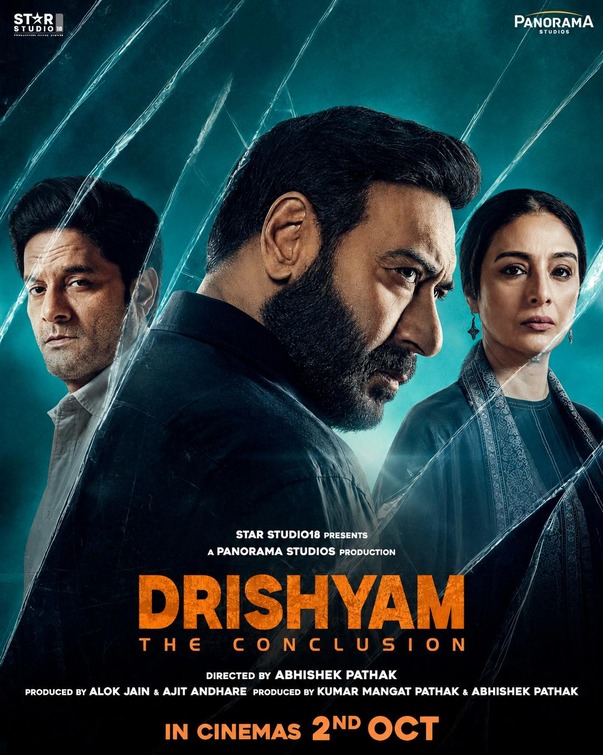
Main image: Drishyam: The Conclusion promotional poster, sourced from IMP Awards. Artwork: Star Studio18 / Panorama Studios; copyright remains with the respective rights holders.
Some film franchises run out of ideas after a sequel or two. But Drishyam has built its own loyal fanbase, and with Drishyam: The Conclusion, the makers deliver one more entertaining round of cat and mouse!
The story began with the mysterious death of a young boy and one man’s determination to protect his family at any cost. That man, of course, is Vijay Salgaonkar, played by Ajay Devgn. After two films of watching him outsmart the police, the big question was: What more could Vijay possibly do? And how much longer could he keep getting away with it?
After the events of the previous film, many viewers might have felt that the case was as good as closed. But clearly, the police had other plans!
This time, a new and formidable police officer enters the picture, while Meera Deshmukh, played by Tabu, finds renewed hope of uncovering the truth about her son. The investigation gathers pace, evidence begins to pile up, and for a while, it looks as though Vijay might finally be cornered.
And then, just when you think you have figured it all out, the film throws another twist at you!
That is the fun of Drishyam. You find yourself admiring the investigators, feeling sorry for the family, and secretly rooting for Vijay to pull off yet another impossible escape. Some revelations are so unexpected that you cannot help but giggle at the sheer audacity of his plans. You almost want to turn around and ask the person sitting next to you, “Did you see that coming?”
Director Abhishek Pathak deserves credit for keeping the story engaging over a runtime of around two and a half hours. The film holds your attention, and you are reluctant to look away because you never know when an apparently insignificant detail might become important. In the world of Vijay Salgaonkar, even the smallest detail can come back to haunt you!
The returning cast also gives the film a sense of continuity. The family members may not have as much to do as Vijay, but they make their presence felt. Shriya Saran, in particular, leaves an impression despite having relatively limited screen time. Her performance captures the vulnerability and emotional weight of someone who has been living under the shadow of a terrible secret.
Ajay Devgn remains the centre of the film, bringing his trademark calm and calculated expressions to Vijay. He rarely needs to say much. Sometimes, one look is enough to make you wonder what he is planning next.
But the performance that really stands out for me is Jaideep Ahlawat as Rajveer Singh Tomar. Whenever he appears on screen, he commands attention. He brings the sharpness, authority and determination needed to make Vijay's life genuinely difficult. For once, you feel that Vijay has encountered someone who might be able to match him move for move.
In fact, I would have loved to see an even more direct face-off between Vijay and Tomar. That intellectual battle could have been a real treat for the audience. Both actors have the screen presence to make such an encounter crackle with tension.
I also enjoyed the character of the church caretaker. There is something about his fragile appearance that makes you underestimate him, which makes his importance to the story all the more interesting. In a film like this, you learn very quickly not to judge anyone by appearances!
What makes the Drishyam franchise work so well is our complicated relationship with Vijay. He is an ordinary man trying to protect his family, and it is easy to understand his desperation. We sympathise with him even when the moral questions become uncomfortable. The police may be trying to uncover the truth, but the audience often finds itself hoping they do not succeed.
That is the cleverness of the storytelling. Vijay is presented as a man who has no extraordinary qualifications, yet repeatedly challenges people with far more formal training and authority. His greatest weapons are observation, patience, planning and an extraordinary ability to think several steps ahead.
There is almost a lesson in strategy here: never underestimate your opponent, and never assume that the person who appears weakest has no plan. Vijay seems to understand this better than anyone. He lets others believe they have the upper hand while he works out his next move.
But the film also leaves us with a bigger question: Does protecting your family make everything you do justified?
It is easy to cheer for Vijay when he outsmarts the police. It is much harder to separate that excitement from the moral consequences of his actions. The film does not need to give us a simple answer. It leaves us to decide where loyalty ends and accountability begins.
Overall, Drishyam: The Conclusion is an entertaining and satisfying final chapter. It delivers the suspense, the twists and the clever plotting that fans have come to expect, while giving Vijay Salgaonkar one last game to play.
And what better way to end a story about a man who is always ten steps ahead than with a conclusion that leaves you looking back at everything you thought you knew?
Verdict: A wonderful watch for fans of the franchise. Go in ready to think, guess, doubt yourself, and perhaps laugh in disbelief when the next twist arrives. Just remember: in Vijay Salgaonkar's world, the moment you think the case is closed is probably the moment you should start worrying!