Having a baby in Singapore can be an exciting experience — but for foreign families, it is also important to understand the financial side well before the due date.
The cost of childbirth in Singapore can vary substantially depending on:
- Whether you are a Singapore Citizen, Permanent Resident or foreigner
- Whether the mother is on an Employment Pass (EP), S Pass, Dependant's Pass or another pass
- Whether you choose a public or private hospital
- Ward type
- Vaginal delivery or Caesarean section
- Your obstetrician's fees
- Length of hospital stay
- Whether an epidural or other procedures are required
- Whether there are complications
- Whether the baby needs additional care after birth
- Your insurance coverage
For a foreigner paying privately, a routine delivery can easily run into several thousand dollars, while private-hospital deliveries can reach well into five figures.
So if you are planning to have a baby in Singapore, don't wait until the third trimester to understand the costs.
First: EP/S Pass, PR and Citizen are treated differently
The biggest financial difference is not necessarily whether you use a public or private hospital.
It is your residency and healthcare-financing status.
Singapore Citizens
Singapore Citizens can receive government subsidies for eligible subsidised treatment in public hospitals and can use MediSave for approved maternity expenses.
Permanent Residents
PRs are eligible for MediShield Life and can use MediSave for the MediSave Maternity Package, subject to the applicable withdrawal limits.
However, PRs generally receive lower government subsidies than Singapore Citizens in subsidised public healthcare. (Ministry of Health)
EP and S Pass holders
Employment Pass and S Pass holders should generally plan on paying significantly more than a subsidised Singapore Citizen or PR when receiving maternity care.
Foreigners do not have access to the MediSave Maternity Package simply because they hold a work pass. The MediSave Maternity Package is available to Singapore Citizens and PRs using their own or their spouse's MediSave at a MediSave-accredited institution. (Central Provident Fund)
However, your employer's medical insurance may cover some or all of the costs depending on your policy.
This is one of the first things to check when you become pregnant.
How much does childbirth cost in Singapore?
There is no single price for "giving birth".
MOH's published hospital bill data gives useful benchmarks, but there is an important caveat: the published figures are based on actual transacted fees for Singapore Citizens, and public-hospital figures may reflect applicable government subsidies. They therefore should not be treated as the price an EP or S Pass holder will necessarily pay. (Ministry of Health)
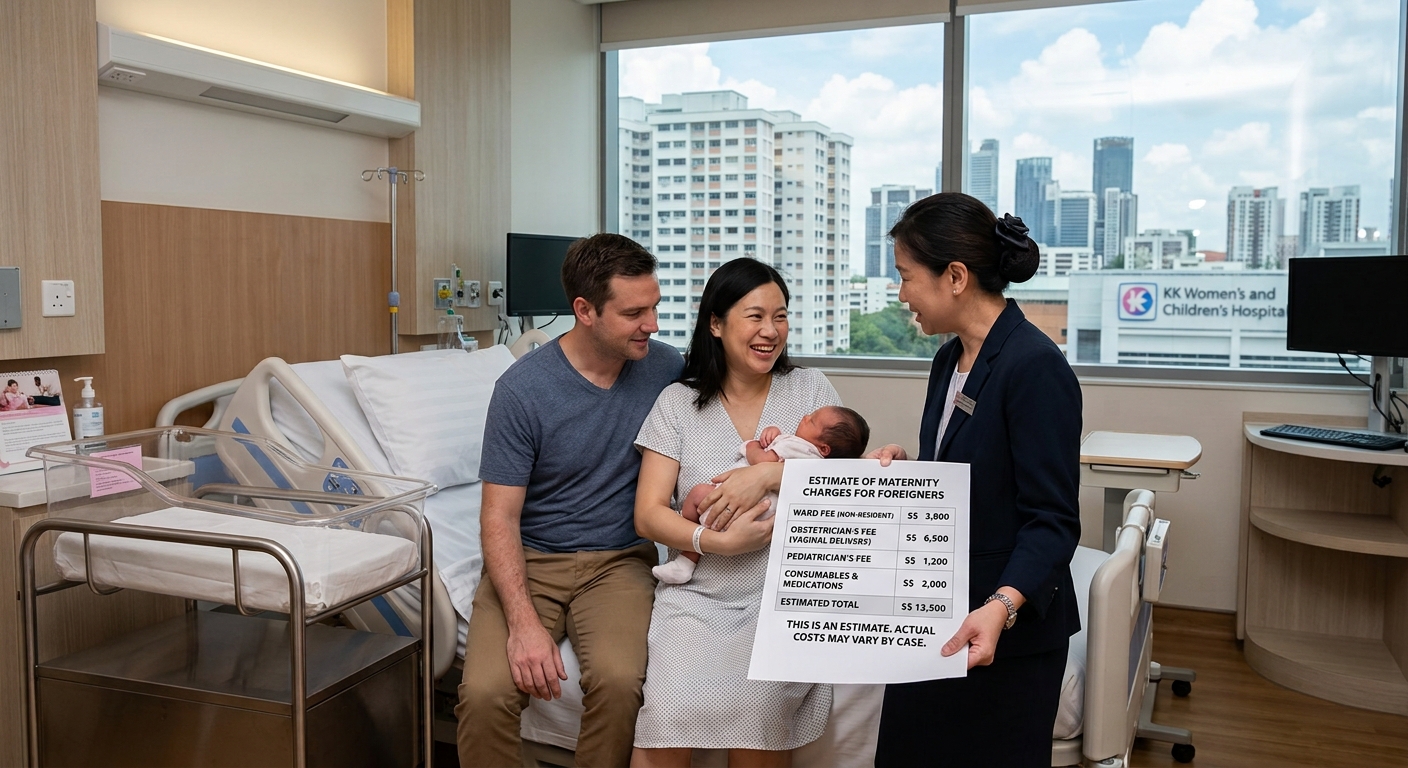
For general planning, private-sector estimates published by Thomson Medical put childbirth at approximately:
| Delivery | Indicative private-hospital cost |
|---|---|
| Vaginal delivery | S$8,000–S$15,000+ |
| Caesarean delivery | S$12,000–S$20,000+ |
These are broad estimates rather than guaranteed package prices. The final bill can be higher if there are complications, additional procedures, a longer hospital stay or extra newborn care. (Thomson Medical)
Public hospitals: don't assume "public" means cheap for foreigners
Singapore's public hospitals provide high-quality maternity care, but a foreigner should not automatically assume that choosing a public hospital means receiving the same subsidised price as a Singapore Citizen.
This distinction is extremely important.
For example, MOH's current bill information for an uncomplicated Caesarean section shows the following overall hospital bill benchmarks:
- Public hospital Ward B2: about S$2,582
- Public hospital Ward C: about S$3,004
- Public hospital Ward B1: about S$8,490
- Public hospital Ward A: about S$9,839
- Private hospital inpatient: about S$15,805
But these MOH figures are based on actual transacted fees for Singapore Citizens and the public-hospital figures may include applicable subsidies. They are therefore not a direct quote for an EP/S Pass holder. (Ministry of Health)
The difference becomes even more significant when you compare the treatment category with a private hospital.
For vaginal delivery, MOH's current overall benchmarks are approximately:
- Public B2: S$1,350
- Public C: S$1,346
- Public B1: S$4,463
- Public A: S$6,024
- Private inpatient: S$10,815
Again, these are Citizen-based benchmark figures before insurance/MediSave payouts and should not be interpreted as the actual foreigner rate. (Ministry of Health)
| Care setting | Caesarean | Vaginal delivery |
|---|---|---|
| Public hospital Ward B2 | about S$2,582 | S$1,350 |
| Public hospital Ward C | about S$3,004 | S$1,346 |
| Public hospital Ward B1 | about S$8,490 | S$4,463 |
| Public hospital Ward A | about S$9,839 | S$6,024 |
| Private hospital inpatient | about S$15,805 | S$10,815 |
What might a foreigner actually budget?
For an EP or S Pass holder paying privately, a sensible planning budget would be higher than the subsidised public-hospital figures.
As a broad planning exercise:
Vaginal delivery
Public hospital: budget several thousand dollars if you are paying foreigner/private rates.
Private hospital: approximately S$8,000–S$15,000+ is a useful starting range.
Caesarean delivery
Public hospital: budget several thousand dollars and obtain a specific estimate from the hospital.
Private hospital: approximately S$12,000–S$20,000+ is a reasonable planning range, with complicated cases potentially costing more.
These figures are deliberately presented as planning ranges rather than promises. Your hospital and doctor should provide a personalised estimate.
Why can the final bill be much higher?
The delivery package is only part of the story.
Your bill can include:
Before delivery
- Obstetrician consultations
- Ultrasounds
- Blood tests
- Genetic screening
- Glucose testing
- Medication
- Additional scans
- Specialist consultations
During delivery
- Delivery suite
- Obstetrician fee
- Anaesthetist
- Epidural
- Operating theatre
- Surgical fee
- Medication
- Medical consumables
- Additional procedures
After delivery
- Hospital room
- Doctor's daily visits
- Medication
- Laboratory tests
- Nursing care
- Newborn assessment
If something unexpected happens
The bill can increase significantly if there is:
- Emergency Caesarean
- Complicated delivery
- Additional surgery
- Postpartum complications
- Longer hospitalisation
- Maternal ICU care
- Premature birth
- Neonatal intensive care
- Special-care nursery admission
This is why an insurance policy that covers only a standard delivery may not provide enough protection against a complicated pregnancy.
Can foreigners use MediSave for childbirth?
Generally, no.
The MediSave Maternity Package is available to Singapore Citizens and Permanent Residents who use their own or their spouse's MediSave savings for maternity expenses at a MediSave-accredited institution. (Central Provident Fund)
The current MediSave Maternity Package allows eligible individuals to use MediSave for:
- Pre-delivery medical expenses
- Delivery procedure
- Daily hospital charges
The withdrawal limits include up to S$900 for pre-delivery expenses, a delivery-related surgical withdrawal limit depending on the procedure, and daily hospital charges of up to S$1,130 per day for the first two days and S$400 per day from the third day onwards. (Central Provident Fund)
So an EP or S Pass holder should not build their maternity budget around MediSave.
What about MediShield Life?
This is another important distinction.
MediShield Life covers Singapore Citizens and Permanent Residents.
It is Singapore's basic national health insurance scheme and is designed primarily around subsidised treatment in public hospitals. Citizens and PRs can still receive MediShield Life coverage when they choose higher-class wards or private hospitals, but the payout covers a smaller proportion of the bill. (Ministry of Health)
Therefore:
Singapore Citizen
MediShield Life: Yes
MediSave maternity benefits: Yes, subject to rules
Public healthcare subsidies: Yes, subject to eligibility/means testing
Permanent Resident
MediShield Life: Yes
MediSave maternity benefits: Yes, subject to rules
Public healthcare subsidies: Yes, but generally lower than Citizen subsidies
EP/S Pass holder
MediShield Life: No
MediSave maternity benefits: No, unless separately eligible through a Singapore Citizen/PR spouse's applicable MediSave arrangement
Public healthcare subsidy: Generally not available in the same way as for Citizens/eligible PRs
Private/employer insurance: Potentially yes, depending on your policy
What if the mother is a foreigner but the father is a Singapore Citizen?
This situation is different and deserves special attention.
MOH has clarified that some foreign spouses of Singapore Citizens can receive healthcare subsidies.
For example, foreign mothers who are Permanent Residents or Long-Term Visit Pass-Plus holders and married to Singapore Citizens can receive the same level of subsidies as Singapore Citizens for the entire delivery episode in public healthcare institutions. (Ministry of Health)
So don't assume:
"I'm a foreigner, therefore I have to pay the full foreigner rate."
Your specific immigration status and family circumstances matter.
Check directly with the hospital's admissions/financial counselling team before delivery.
Is pregnancy covered by employer insurance?
It can be — but don't assume it is.
This is particularly important for EP and S Pass holders.
Some employer medical plans may provide maternity benefits, while others may exclude:
- Pregnancy
- Normal delivery
- Elective Caesarean
- Antenatal care
- Certain pregnancy complications
- Newborn expenses
Your employer's HR or insurer should be able to tell you exactly what is covered.
Ask for the answer in writing.
Ask these questions:
1. Is normal vaginal delivery covered?
2. Is Caesarean delivery covered?
3. Is emergency Caesarean covered?
4. Are antenatal consultations covered?
5. Are scans covered?
6. Is the epidural covered?
7. Are pregnancy complications covered?
8. Is the newborn covered?
9. Is NICU covered?
10. Is there a maternity waiting period?
11. Is there a maximum maternity benefit?
12. Is there a hospital or room-rate restriction?
13. Do I need pre-authorisation?
14. Do I have to use a panel hospital or doctor?
These questions can make a difference of thousands of dollars.
Can you buy private maternity insurance after becoming pregnant?
This is where you need to be careful.
Maternity insurance policies have their own eligibility requirements, waiting periods and exclusions.
You cannot assume that buying a policy after discovering you are pregnant will result in full coverage for the existing pregnancy.
Some maternity plans are designed to be purchased before conception or during an early stage of pregnancy, and coverage varies considerably.
Read:
- Waiting periods
- Pregnancy eligibility
- Pre-existing conditions
- Complications
- Delivery coverage
- Newborn coverage
- Congenital conditions
- NICU coverage
- Maximum claim limits
before purchasing a policy.
For foreigners, availability and eligibility can also depend on residency status.
What about the baby's hospital bill?
This is an area parents sometimes overlook.
Your own maternity bill and your baby's medical bill are not necessarily the same thing.
If the baby needs:
- Special-care nursery
- Phototherapy
- Additional tests
- Paediatric specialist review
- NICU
- Treatment for complications
there can be additional charges.
And this is where newborn insurance becomes particularly important.
If you have employer insurance, ask:
"When does my newborn become eligible for coverage, and how do I add the baby to the policy?"
Do this before the birth if possible.
Public hospitals offering maternity services
Singapore has several public hospitals providing obstetric and maternity care.
Important options include:
KK Women's and Children's Hospital
KK Women's and Children's Hospital Web Address: 100 Bukit Timah Rd, Singapore 229899 Phone: +6562255554
KKH is Singapore's major specialist hospital dedicated to women and children and is a natural option for families looking for comprehensive obstetric and paediatric care.
KKH provides antenatal packages, delivery services and financial counselling, and has an online estimated delivery bill calculator. (KKH)
Address: 100 Bukit Timah Road, Singapore 229899
National University Hospital
National University Hospital Web Address: 5 Lower Kent Ridge Rd, Singapore 119074 Phone: +6567795555
NUH is another major public hospital offering obstetric and maternity services, including specialist care.
NUH's published fee information specifically notes that charges can differ between Singapore Citizens, Permanent Residents, Resident Foreigners and Non-Residents. (NUH)
Address: 5 Lower Kent Ridge Road, Singapore 119074
Other public options
Other public hospitals with maternity services include:
- Singapore General Hospital
- Sengkang General Hospital
- Ng Teng Fong General Hospital
However, maternity services and the availability of specific specialist programmes can vary, so check directly with the hospital.
Private hospitals offering maternity services
Singapore has a number of private hospitals with established maternity services.
Some of the better-known options include:
Thomson Medical Centre
Thomson Medical Centre Web Address: 339 Thomson Rd, Singapore 307677 Phone: +6598466766
Thomson Medical is a dedicated private maternity and women's-health provider and is well known among Singapore families and expatriates.
It offers different maternity packages and room options. Thomson's published guidance currently estimates private childbirth at approximately S$8,000–S$15,000+ for vaginal delivery and S$12,000–S$20,000+ for Caesarean delivery. (Thomson Medical)
Address: 339 Thomson Road, Singapore 307677
Mount Alvernia Hospital
Mount Alvernia Hospital Web Address: 820 Thomson Rd, Singapore 574623 Phone: +6563476688
Mount Alvernia is another established private hospital with maternity services and obstetricians.
It provides maternity care alongside paediatric and other medical services.
Address: 820 Thomson Road, Singapore 574623
Other private options
Other hospitals/facilities that may be considered include:
- Gleneagles Hospital
- Mount Elizabeth Hospital
- Mount Elizabeth Novena Hospital
- Raffles Hospital
Two public hospitals to put on your shortlist
For a DesiNewz guide, I would highlight:
1. KKH
Why consider it: Specialist women-and-children hospital, comprehensive maternity and neonatal services, and dedicated financial counselling.
It is particularly relevant if you want access to a large specialist maternity ecosystem.
2. NUH
Why consider it: Major public teaching hospital with obstetric services and specialist capabilities.
It can be particularly relevant for pregnancies requiring specialist or multidisciplinary care.
These aren't rankings — the right hospital depends on your pregnancy, doctor, insurance, location and preferred level of care.
Two private hospitals to put on your shortlist
1. Thomson Medical Centre
Why consider it: Strong focus on maternity, women's health and newborn care, with dedicated maternity packages.
2. Mount Alvernia Hospital
Why consider it: Established private maternity service with obstetric and paediatric care.
Again, parents should compare the actual package, doctor fees, room type and insurance coverage rather than choosing a hospital based only on headline package prices.
Public vs private: what should a foreigner consider?
| Public Hospital | Private Hospital | |
|---|---|---|
| Cost | Usually lower, but foreigner rates matter | Generally higher |
| Choice of doctor | More limited depending on care pathway | Usually greater choice |
| Room choices | Multiple ward classes | Generally more private-room options |
| Specialist care | Extensive | Extensive |
| Maternity packages | Available | Widely available |
| Insurance | Depends on policy | Depends on policy |
| Convenience | Depends on hospital/pathway | Often more personalised |
| Foreign patient rates | Apply | Private rates |
| Emergency care | Comprehensive | Comprehensive |
One important point: public does not mean low-cost for a foreigner, and private does not automatically mean better medical care.
Your decision should consider the pregnancy, doctor's recommendation, insurance, budget, preferred room type and the hospital's specialist capabilities.
Before choosing your hospital, ask for a written estimate
This is perhaps the most useful advice for an expatriate family.
Ask the hospital:
"I am an EP/S Pass holder and I do not have MediSave. Can you provide an estimated total cost for my delivery, including doctor's fees, hospital charges, room, anaesthetist, epidural and newborn charges?"
Then ask:
"What would the estimated cost be if I need an emergency Caesarean?"
And:
"What costs are excluded from the package?"
This last question is extremely important.
A package advertised at a certain price may not necessarily include every medical expense.
What to ask your insurance company
Before your third trimester, get a written answer to these questions:
☐ Is pregnancy covered?
☐ Is normal delivery covered?
☐ Is Caesarean covered?
☐ Is emergency Caesarean covered?
☐ Are antenatal consultations covered?
☐ Are ultrasounds covered?
☐ Is epidural covered?
☐ Are pregnancy complications covered?
☐ Is postpartum care covered?
☐ Is the newborn covered?
☐ Is NICU covered?
☐ Is there a waiting period?
☐ What is the maximum maternity benefit?
☐ Is there a room-and-board limit?
☐ Do I need pre-authorisation?
☐ Do I need to use a panel hospital?
☐ Do I need to use a panel obstetrician?
☐ What is my expected cash outlay?
A simple example
Imagine an EP holder chooses a private hospital.
The family may have:
Antenatal care: S$2,000+
Delivery/hospitalisation: S$8,000–S$15,000+ for a vaginal delivery
Potential additional costs: epidural, extra scans, tests, complications, newborn treatment
The total can therefore become considerably higher than the advertised delivery package.
If a Caesarean is required, a private-hospital bill can move into the S$12,000–S$20,000+ range, with complicated cases potentially exceeding this. (Thomson Medical)
This is why having insurance — or a substantial maternity budget — matters.
What if you cannot afford the bill?
If you are a foreigner facing financial difficulty, don't simply ignore the bill.
MOH says foreigners facing financial difficulties with healthcare bills can approach medical social workers for assistance. Public hospitals can assess individual circumstances and available forms of assistance. (Ministry of Health)
Ask the hospital's financial counselling or medical social work team what options are available.
What about the cost of the baby's healthcare after birth?
Remember that childbirth is only the beginning.
Budget separately for:
- Paediatric consultations
- Vaccinations
- Newborn screening
- Medication
- Follow-up appointments
- Lactation support
- Paediatric specialist appointments if required
- Emergency care
- Future hospitalisation
For Singapore Citizen babies born after 1 April 2025, the Government provides a S$5,000 MediSave Grant for Newborns, which can help with healthcare expenses including MediShield Life premiums and approved medical expenses. (Ministry of Health)
The baby's citizenship and immigration status therefore matter when planning long-term healthcare costs.
Quick guide: What should you budget?
| Family status | Healthcare financing | Planning approach |
|---|---|---|
| Singapore Citizen | MediShield Life + MediSave + eligible public subsidies | Check MediSave and insurance before delivery |
| PR | MediShield Life + MediSave + eligible public subsidies | Check MediSave, insurance and PR subsidy level |
| EP holder | Employer/private insurance if available; otherwise cash/private payment | Obtain written insurance confirmation and hospital estimate |
| S Pass holder | Employer/private insurance if available; otherwise cash/private payment | Obtain written insurance confirmation and hospital estimate |
| Foreign spouse of Singapore Citizen | May qualify for specific subsidies depending on status | Check PR/LTVP+ status and hospital eligibility |
| Dependant's Pass holder | Depends mainly on private/employer insurance and residency status | Check policy carefully |
Bottom line for foreigners
Giving birth in Singapore can be expensive, particularly if you are an EP or S Pass holder without comprehensive maternity insurance.
The good news is that Singapore has a wide range of maternity services, from specialist public institutions such as KKH and NUH to private maternity providers such as Thomson Medical Centre and Mount Alvernia Hospital.
The important thing is not simply to ask:
"How much does it cost to give birth in Singapore?"
Instead ask:
"How much will childbirth cost for someone with my pass, at my hospital, with my insurance, and what happens if I need a Caesarean or my baby needs additional care?"
That answer will be far more useful — and could save your family thousands of dollars.
Official resources to check before making a decision
- MOH hospital bill information: use the Ministry of Health's fee benchmarks to understand current hospital bill ranges. (Ministry of Health)
- CPF Board MediSave Maternity Package: check the latest withdrawal limits and eligibility. (Central Provident Fund)
- MediShield Life: check eligibility and coverage for Citizens and PRs. (Ministry of Health)
- KKH: check the hospital's delivery bill calculator and financial counselling information. (KKH)
- NUH: check current fees and foreign-resident/non-resident charges directly with the hospital. (NUH)
Prices and insurance policies can change. Always obtain a current written estimate from the hospital and confirmation from your insurer before relying on any figure in this article.
Where to verify: This article is general editorial information, not legal, immigration, medical or financial advice. Requirements can change. Check the relevant Singapore government agency or a qualified professional for advice about your situation.