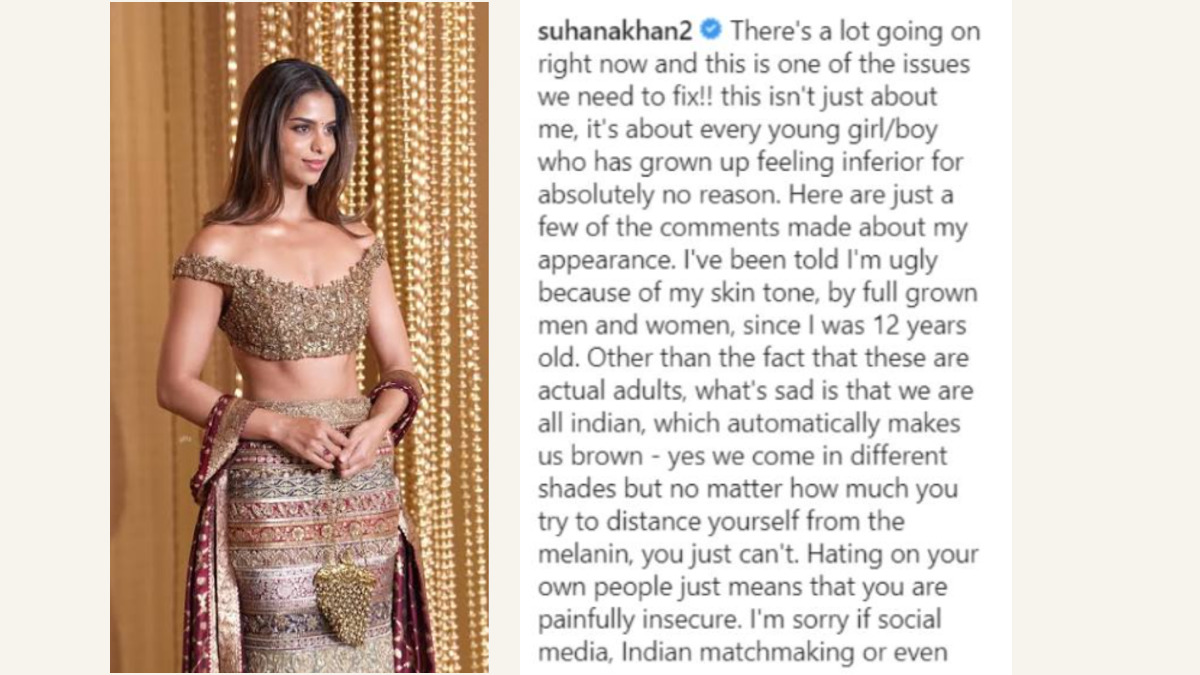
The recent conversation around Suhana Khan's appearance during Diwali once again brought attention to something that has troubled Indian society for generations: our obsession with fair skin.
Suhana was just 12 when adults began telling her that she was ugly because of her skin tone. In September 2020, she spoke publicly about the abuse she had received, sharing screenshots of some of the comments. What stayed with me was how quickly she moved the conversation beyond herself. She said, "It's about every young girl/boy who has grown up feeling inferior for absolutely no reason."
Think about what it means for a young child to hear such things from adults. Being Shah Rukh Khan's daughter may give her the resources and confidence to speak up, but it does not make those words hurt any less.
Nysa Devgan, daughter of Kajol and Ajay Devgn, has also faced public trolling over her complexion. The irony is that even Kajol has been subjected to speculation about changes in her own skin tone and whether she has undergone treatments to look lighter than she did in her earlier films.
Now think about the girl next door who hears similar comments in her school group chat and then comes home to a relative telling her that she would look prettier if she stayed out of the sun. Who does she turn to when the very people she would normally seek comfort from are repeating a gentler version of the same insult?
The habit keeps finding new subjects.
In October 2026, India Today reported how some social media users questioned whether Sai Pallavi's complexion and features fitted their idea of Sita in Nitesh Tiwari's Ramayana. Others came forward to defend her.
There is nothing wrong with discussing casting choices or debating whether an actor is suitable for a particular role. That is part of being an audience. But it is revealing when the conversation focuses more on an actor's skin tone than on what she might bring to the character.
What can an actor bring to Sita's courage, dignity, grace and emotional strength? How can she interpret the character and bring her alive on screen? Surely, these are far more interesting questions than whether she fits somebody's idea of a beautiful face.
Earlier that year, Aishwarya Rai Bachchan's appearance at Cannes also attracted comments about her body and appearance. And, Katrina Kaif’s appearance after child birth. Body shaming and colorism are not the same thing, but both can stem from a similar assumption: that a woman who appears in public has invited strangers to judge and grade her appearance.
Where Did We Learn to Associate Fair Skin with Beauty?
The British Raj helped strengthen racial hierarchies that associated whiteness with power, privilege and status. However, the history of colourism in India is older and more complicated than simply saying that the British introduced it.
Our skin tones are also shaped by geography, climate and ancestry. India has different climatic conditions and levels of sun exposure across its regions, which, over generations, have contributed to variations in skin pigmentation. Melanin, the pigment responsible for skin colour, also plays an important role in protecting the skin from UV radiation. With people moving across regions for centuries through trade, migration and marriage, communities have mixed, creating an incredible diversity of skin tones across India. There is no single Indian skin tone, and certainly no scientific basis for treating one shade as more beautiful or superior to another.
Historian Nitin Sinha's research traces how beauty advertising in late colonial India promoted racialised ideas of modernity while drawing upon existing social divisions. Later, researchers Radhika Parameswaran and Kavitha Cardoza examined how Indian fairness advertisements turned these ideas into stories about who gets to be considered desirable, successful and socially acceptable.
Think about the message behind a fairness cream advertisement. It was never just about changing one's skin tone. It was about promising a different life — greater confidence, better marriage prospects, professional success and social acceptance.
The promise only worked if people were made to believe that there was something wrong with the life, and the skin, they already had.
And yet, there are other ways of looking at skin colour in the very traditions many of us grew up with.
The Smithsonian's National Museum of Asian Art notes that Krishna, Rama and Vishnu are often depicted with dark blue or black skin, sometimes associated with the colour of the cosmos.
This does not mean that society historically treated everyone with darker skin equally. But it does raise an interesting question worth reflecting upon: How can darkness be something we associate with the divine in a painting, a prayer or a religious story, yet speak of it as a disappointment when a child is born?
The Lesson Often Begins at Home
The problem is that colourism does not always come in the form of an obvious insult. Often, it begins with seemingly innocent comments.
At a family gathering, one child is praised for being fair. Another is told that she is pretty despite having a darker complexion. Someone casually advises a young girl not to spend too much time outdoors because she might become darker.
Nobody thinks they are doing any harm. They may even believe they are offering friendly advice.
But children are listening. They observe what gets praised, what gets criticised and what is considered desirable. Slowly, they begin to understand that fair skin is something to aspire to, while darker skin is something that needs to be explained, defended or even corrected.
And this lesson does not stop at childhood. It follows people into adulthood, relationships and marriage.
A study examining matrimonial advertisements published in India's Sunday Times found that complexion was mentioned much more frequently in advertisements placed by prospective brides or their families than in those placed by prospective grooms or their families. When complexion was mentioned, lighter skin was the preferred attribute.
One day's matrimonial advertisements cannot represent every Indian family, but the findings reflect a familiar double standard. A man is often evaluated on what he does, his education and his financial standing. A woman, meanwhile, can find that her appearance and complexion are treated as part of her qualifications.
And what do boys learn from these conversations? What expectations do they develop about the women they will eventually choose as partners?
The Impact Goes Beyond Hurt Feelings
We often tell young people to ignore negative comments, develop a thick skin and move on. But repeated humiliation, especially during formative years, can have a lasting impact.
A review of studies following children and teenagers over time found that those who experienced cyberbullying were more likely to report symptoms of depression and anxiety later in life.
While this research examines cyberbullying broadly and is not specific to colour-based abuse, it helps explain why repeatedly telling someone to ignore online harassment is not an adequate response.
There is a cost to everyone else, too.
Think about a girl who decides she would rather stay away from the class photograph, skip an audition or keep her hand down in a classroom because she does not want to attract attention or become the subject of another joke.
The room may never know what it missed. It may never discover her confidence, talent or potential simply because she has been made to feel that she is not good enough.
That is perhaps the bigger tragedy. We are not just hurting someone's feelings. We could be limiting their confidence and the opportunities they allow themselves to pursue.
What Has Changed, and What Can We Do Next?
There have been efforts to challenge this mindset.
Women of Worth launched the Dark Is Beautiful campaign in 2009, with actor Nandita Das helping bring the message to a wider audience. The campaign challenged the idea that lighter skin was a prerequisite for beauty, confidence or success.
In 2014, the Advertising Standards Council of India introduced guidelines asking advertisers of skin-lightening products to avoid portraying darker-skinned people as unattractive, unhappy or unsuccessful, or suggesting that complexion determines one's future.
In 2020, Hindustan Unilever renamed its popular Fair & Lovely brand to Glow & Lovely. It was an important acknowledgement of the changing conversation around beauty and skin tone.
These efforts matter. They have helped question messages that had been repeated for decades, often without much resistance.
But a change in a product's name does not necessarily mean a change in society's thinking. A girl may no longer see the word 'fair' on a cream advertisement, but she may still hear the same expectation at home. A brand may change its messaging, but the idea that a lighter complexion is more desirable can continue to influence casting decisions, matrimonial preferences and everyday conversations.
The real change has to happen beyond advertisements and campaigns.
There is work to be done in the very places where these attitudes are passed on.
A parent, uncle or grandparent can simply say, "We don't talk about someone's skin like that."
A teacher can take a complexion-based nickname as seriously as any other form of repeated bullying.
A filmmaker can cast women with darker skin as romantic leads without making their complexion a talking point or part of the storyline.
Entertainment publications and social media platforms can stop amplifying cruel comments for engagement and do more to moderate abusive conversations.
And when someone dismisses a remark as harmless, perhaps we should pause and ask: What would a child listening to this learn?
Let Children Grow Up Without Having to Question Their Skin
There is beauty in grace, confidence, kindness and the way someone expresses herself. But even these qualities should not become another set of expectations that a girl has to fulfil to be accepted.
We often talk about raising confident children, encouraging young girls to dream big and creating an environment where everyone feels equal. Yet, sometimes, the very same adults who advocate these values unknowingly undermine them through everyday remarks about appearance.
The next time a young woman walks onto a stage, appears in a film or simply walks into a family gathering, let us give her the ordinary freedom of being there without turning her skin tone into a subject of discussion.
Perhaps the change we need is not as complicated as we think.
It begins with what we say at home, what we praise in our children and what we choose not to laugh at.
Fair skin should never be a qualification for beauty, acceptance or success. And no child should grow up believing otherwise.
Sources
- The Indian Express — Suhana Khan on being called ugly because of her skin tone
- The Times of India — Trolling of Nysa Devgan over her skin tone
- India Today — Sai Pallavi as Sita: Why must a goddess pass India's beauty test?
- The New Indian Express — Ageing with authenticity at Cannes
- Research on colonial beauty advertising
- Radhika Parameswaran and Kavitha Cardoza — Melanin on the Margins
- Smithsonian National Museum of Asian Art — Krishna Fluting
- India's Color Complex: One Day's Worth of Matrimonials
- Longitudinal review of cyberbullying and youth mental health
- Women of Worth — Dark Is Beautiful Campaign
- Advertising Standards Council of India — Advertising Guidelines
- Hindustan Unilever — Glow & Lovely
Where to verify: This article is general editorial information, not legal, immigration, medical or financial advice. Requirements can change. Check the relevant Singapore government agency or a qualified professional for advice about your situation.