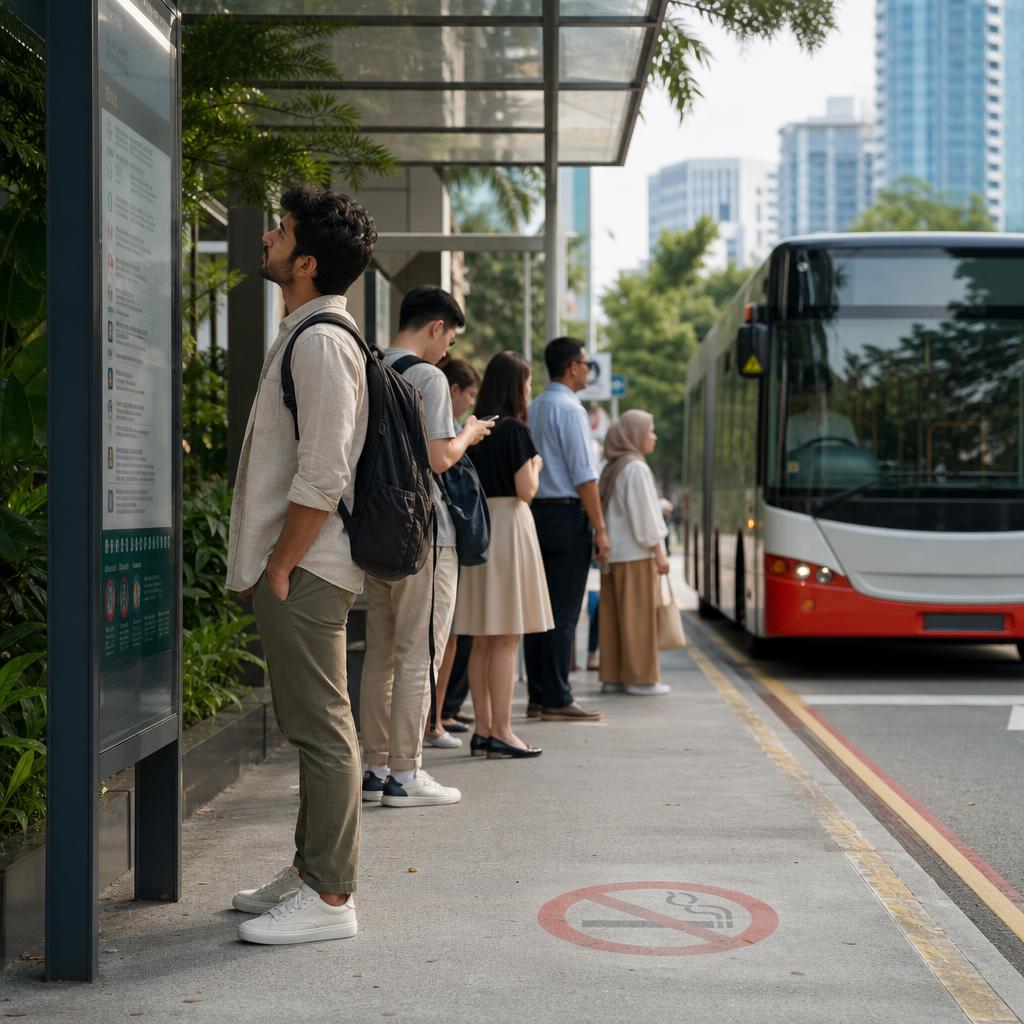
Singapore is known for being clean, orderly and remarkably well organised.
But if you have recently moved here, some of the rules governing everyday behaviour may make you pause and think: “Wait… that’s actually a rule?”
From keeping your feet off bus seats to flushing public toilets and keeping neighbourhood noise under control, Singapore has some very specific rules about how people share public spaces.
Here are six that may surprise newcomers—explained without the legal jargon.
1. Yes, putting your feet on a bus seat can get you into trouble
Starting 23 September 2026, Singapore’s new public bus regulations will make certain nuisance and disruptive behaviours offences.
One example? Putting your feet on a bus seat.
Playing audio loudly, littering, eating or drinking on buses are also covered by the new regulations. The maximum penalty for these specified offences is S$500.
So that comfortable-looking bus seat in front of you is still a seat—not a temporary footrest.
The new regulations also cover behaviour at bus interchanges and terminals, with more serious offences carrying penalties of up to S$5,000.
Why it may surprise foreigners: In many countries, putting your feet on an empty seat might simply earn you a few disapproving looks. In Singapore, certain forms of this behaviour are specifically covered by regulations.
2. Eating and drinking on buses is not just about keeping things clean
Singapore’s new bus regulations also specifically cover eating and drinking onboard public buses.
This may seem surprising to someone arriving from a city where grabbing a coffee or eating a quick snack during a bus ride is perfectly normal.
The reason is fairly practical: food and drinks can create spills, smells, litter and inconvenience for other passengers—particularly in a crowded, enclosed space.
Under the new regulations taking effect on 23 September 2026, eating and drinking onboard buses can attract a maximum penalty of S$500.
So perhaps finish that bubble tea before boarding.
Your fellow passengers—and the next passenger who gets your seat—may appreciate it.
3. Is there actually a law against “stinking” in public?
This is one of those Singapore rules that often gets repeated online—but it needs a little clarification.
There is not a simple standalone law saying that you can be fined because you smell bad.
However, Singapore’s community-dispute framework does recognise excessive smell or smoke as a possible form of unreasonable interference with a neighbour’s enjoyment of their home.
The Community Disputes Resolution Tribunals can deal with certain disputes involving unreasonable interference, including excessive noise, smell or smoke, vibration, light, littering and obstruction.
That is quite different from saying: “You smell bad, therefore you have broken the law.”
So don’t panic if you’ve forgotten your deodorant one morning.
The rules are aimed at serious and unreasonable nuisance, particularly in disputes between neighbours.
4. Noise pollution can become a serious legal matter
This one is particularly relevant if you live in an apartment.
Singapore has recently strengthened its approach to severe and prolonged neighbour noise disputes.
From 1 September 2026, the Community Relations Unit (CRU) has been expanded nationwide to deal with severe neighbour noise cases in both public and private housing.
The CRU can investigate serious cases, including taking statements and using noise sensors to gather objective evidence about the timing, direction and intensity of noise. In appropriate cases, officers can issue orders requiring the noise nuisance to stop.
There is also a new mediation framework under which authorities can direct disputing neighbours to attend mediation. A person who does not comply with a mediation direction can face a fine of up to S$1,500.
This doesn’t mean your neighbour can call the authorities because you dropped a pan at 8pm.
The measures are intended for severe and prolonged disputes, particularly where other attempts to resolve the problem have not worked.
Still, it might be worth remembering before starting that enthusiastic midnight karaoke session.
5. You are expected to flush a public toilet after using it
This may sound like basic courtesy rather than something that needs legislation.
But in Singapore, it is actually covered by the regulations.
Under the Environmental Public Health (Public Cleansing) Regulations, anyone who uses a sanitary convenience with a flushing system that is accessible to the public is required to flush immediately after use.
In other words, Singapore has taken the philosophy of “Please flush after yourself” and given it a legal backbone.
Public-access toilets are also subject to requirements relating to things such as toilet paper, soap or liquid detergent and hand-drying facilities.
6. Smoking near a bus stop? Check the five-metre rule
Singapore has extensive smoking restrictions, and this can catch newcomers by surprise.
Smoking is prohibited at bus stops, bus shelters and bus poles, including within a five-metre radius.
It is also prohibited in many other places, including public service vehicles, covered linkways, bus interchanges and terminals, playgrounds, many parks and gardens, and various public facilities.
So, if you see someone standing a little way away from a bus stop while smoking, they may not simply be trying to avoid the crowd.
They may be observing the five-metre rule.
Singapore’s approach is essentially: if you’re going to smoke, make sure you’re somewhere smoking is actually permitted.
Why does Singapore have so many detailed rules?
For someone new to Singapore, some of these regulations can initially feel unusually specific.
But there is a common thread running through many of them: shared spaces.
Buses, MRT stations, neighbourhoods, public toilets, footpaths and parks are used by millions of people every day. Small inconveniences can become much bigger problems when they happen repeatedly across a densely populated city.
That is why Singapore’s rules often go beyond simply saying “be considerate” and spell out what that can mean in practice.
And perhaps that is the most Singaporean thing about them.
The message is simple: your personal space may be yours, but once you step into a shared space, your behaviour affects everyone around you.
The unofficial checklist for newcomers
- Feet off the bus seat.
- Food stays off the bus.
- Keep the volume down.
- Don’t turn your neighbour’s home into a concert venue.
- Flush the toilet.
- Check that five-metre smoking boundary.
Singapore may be small—but apparently, the rulebook has plenty of room.
Sources and further reading
Entry rules, prices, schedules and opening hours can change. Check current official guidance before booking or travelling.
Where to verify: This article is general editorial information, not legal, immigration, medical or financial advice. Requirements can change. Check the relevant Singapore government agency or a qualified professional for advice about your situation.