Having a baby in Singapore is an exciting time — but if both parents are foreigners, there is also a fair amount of paperwork to complete after the delivery.
From registering the birth and deciding the baby's name to obtaining the birth certificate, applying for the baby's passport and securing the child's immigration status, there are several steps that need to happen relatively quickly.
The most important date to remember is:
⚠️ THE 42-DAY DEADLINE
A child born in Singapore who is not a Singapore citizen at birth is automatically granted a Special Pass valid for 42 days from the date of birth.
The parents must make sure that the child has an appropriate immigration pass to remain legally in Singapore after those 42 days.
This does not mean that your baby's Dependant's Pass must necessarily be approved within 42 days. It means that the child's stay in Singapore must be properly regularised before the Special Pass expires.
If the baby's passport is not ready, there are mechanisms to extend the Special Pass in appropriate circumstances. (ICA)
Do not leave this process until the last week.
⚠️ IMPORTANT DISCLAIMER
This article is a practical guide based on Singapore government and hospital information available in September 2026. It is not immigration, legal, medical or financial advice.
The exact process can vary depending on:
- the parents' nationality
- whether the parents are married
- whether one or both parents hold an Employment Pass, S Pass, PR or another immigration status
- whether the child qualifies for Singapore citizenship
- the parents' embassy/passport requirements
- the hospital
- the baby's medical circumstances
- whether additional documents or verification are required
Passport procedures are particularly country-specific.
Therefore, parents should check the relevant embassy/high commission as early as possible and confirm the current requirements directly with ICA, MOM and their embassy.
First: Does the baby automatically become a Singapore citizen?
No.
Being born in Singapore does not, by itself, mean that a child of foreign parents automatically becomes a Singapore citizen.
The child's citizenship depends on the applicable citizenship laws and the parents' circumstances.
If neither parent is a Singapore citizen, parents should generally expect to obtain the child's birth certificate, nationality/travel document and Singapore immigration status rather than assume that the baby automatically receives Singapore citizenship.
If one parent is a Singapore citizen, the situation can be different and parents should check ICA's citizenship rules. ICA provides separate procedures for children who qualify for Singapore citizenship. (ICA)
Before the baby is born: Prepare your paperwork
Although this article focuses on what happens after delivery, the easiest way to reduce stress is to prepare before the baby arrives.
Keep copies of:
- both parents' passports
- both parents' Singapore immigration/work passes
- marriage certificate
- relevant medical documents
- expected delivery information
- contact details of your embassy/high commission
- health insurance information
- employer HR/relocation contact
- baby's intended name
One particularly important step
Contact your embassy or high commission before the delivery.
Ask:
What do we need to do after our baby is born in Singapore to obtain the baby's passport or travel document?
Requirements differ between countries. Don't assume that your country's passport procedure will be identical to another family's experience.
DAY 0: The baby is born
Congratulations — but there are a few practical things to take care of before leaving the hospital.
The hospital will handle the medical side of the delivery and provide the relevant discharge and follow-up information.
For example, KKH advises parents to bring identification documents/passports for admission and schedules postnatal follow-up after discharge. (KKH)
Ask the hospital what documents you will receive
Before leaving, keep copies of all relevant documents relating to the mother and baby.
These may include:
For the baby
- birth-related hospital documentation
- discharge information
- baby's medical records/information
- vaccination/immunisation information where provided
- newborn screening information, where applicable
- any medical reports or referrals
For the mother
- discharge summary
- delivery-related medical documentation
- prescriptions
- postnatal appointment information
- medical certificates, if applicable
If you later need an official medical report or additional copy of a discharge summary, hospitals may have separate application processes and fees.
For example, KKH states that duplicate inpatient discharge summaries and other medical records can be requested separately. (KKH)
Keep your hospital bill documents too
Keep:
- hospital invoice/final bill
- deposit receipt
- payment receipts
- insurance claim documents
- employer Letter of Guarantee, if applicable
- itemised bills if provided
- baby's separate charges, if separately billed
These can become important for insurance claims and reimbursement.
DAY 1–7: Register the baby's birth
This is the first major administrative step.
Birth registration is now online
Since 29 May 2022, parents no longer register births physically at the maternity hospital.
All births in Singapore must be registered through LifeSG within 42 days of the baby's birth.
This applies regardless of the parents' immigration or marital status. (ICA)
The hospital does not complete the registration for you.
What information do you need for birth registration?
You will need to provide information about the baby, including:
- baby's name
- sex
- date of birth
- time of birth
- place of birth
For a hospital birth, parents generally do not need to manually enter certain birth particulars because these can be provided by the hospital. (ICA)
You will also provide information about the parents, including:
- full name
- identity document number
- date of birth
- place/country of birth
- nationality/citizenship
- race
- dialect group, where applicable
What documents might you need?
ICA says parents may be asked to provide:
- marriage certificate, if the marriage information is not available through Singpass/MyInfo
- passport biodata page, where a parent is an immigration/work-pass holder without a Singpass account
Documents that are not in English require appropriate official translation. (ICA)
Practical tip
Before starting the registration, have digital copies of:
Both parents' passports + marriage certificate + immigration/work passes
ready.
This avoids searching for documents while completing the application.
What about the baby's name?
This is something parents should ideally decide before starting birth registration.
The name entered into the Singapore birth registration becomes important because it can subsequently appear on the child's travel document/passport and immigration records.
ICA specifically notes that if a Hanyu Pinyin name is included in the birth certificate, it will also be reflected in the child's passport. (ICA)
So don't treat the name as something you can casually change later.
ICA does allow parents to apply online to alter a child's name before the child turns one, subject to the prescribed fee. (ICA)
Our practical advice:
Agree on the baby's legal name before registering the birth.
Check:
- spelling
- surname
- order of names
- middle names
- ethnic name, if applicable
- how the name will appear on the passport
A mismatch between the birth certificate and passport can create unnecessary administrative complications later.
How much does birth registration cost?
ICA currently charges:
S$18
for birth registration and issuance of the digital birth certificate. (ICA)
How quickly will you receive the birth certificate?
For an online birth registration, ICA says parents will receive a digital notification shortly after successful registration.
If further verification is required, notification of successful registration is generally provided within three working days, although some cases can take longer. (ICA)
There is no longer a physical birth certificate issued for births registered from 29 May 2022.
You download the digital birth certificate from ICA's e-Service.
ICA advises parents to download it within 90 days and keep a copy safely. (ICA)
DAY 1–14: Start the baby's passport application
This is where parents should move quickly.
If the baby is not a Singapore citizen, ICA states that parents should apply for a passport from the relevant embassy/high commission within 42 days of birth, after receiving the birth certificate. (ICA)
MOM similarly advises eligible EP/S Pass holders to obtain the baby's passport and apply for the Dependant's Pass within six weeks of birth. (Ministry of Manpower Singapore)
Why should you start immediately?
Because passport processing times depend on your country.
The Singapore government cannot issue your baby's foreign passport.
The baby's passport or travel document has to come from the country whose nationality the child holds.
Therefore:
Singapore birth registration → birth certificate → embassy/passport process → Singapore immigration pass
is the basic sequence for many foreign families.
What will the embassy ask for?
There is no single list that applies to every nationality.
However, parents should be prepared for documents such as:
- baby's Singapore birth certificate
- both parents' passports
- parents' marriage certificate
- passport photographs of the baby
- embassy application forms
- proof of the parents' nationality
- citizenship/birth registration documentation
- parental consent, where applicable
Check your own embassy's requirements before the baby is born.
Do not rely on a checklist from another nationality.
DAY 7–21: Apply for the baby's Dependant's Pass
If one parent is an eligible Employment Pass or S Pass holder, the employer can apply for a Dependant's Pass for the baby.
This is important:
The parent normally does not submit the DP application personally.
The employer applies through MOM's myMOM Portal.
MOM states that eligible EP or S Pass holders can have their company apply for a Dependant's Pass for a newborn. (Ministry of Manpower Singapore)
What documents are required for the baby's DP?
MOM's requirements include:
- copy of the baby's passport personal particulars page
- baby's official birth certificate showing the parents' names
- other supporting documents if requested
Non-English documents require the original document together with an English translation. (Ministry of Manpower Singapore)
What if the passport isn't ready yet?
This is an important scenario.
MOM states that if the baby's passport is not ready, the employer can submit proof that the passport application has been made — for example, a letter from the embassy confirming the application.
In that situation, the baby's Special Pass may need to be extended. (Ministry of Manpower Singapore)
How long does the Dependant's Pass take?
MOM says online applications generally receive an outcome within three weeks for most cases. (Ministry of Manpower Singapore)
But don't interpret "three weeks" as a reason to wait three weeks before starting.
The sequence can involve:
Birth → birth registration → birth certificate → embassy passport application → passport → employer DP application → DP issuance
If any one of these stages takes longer, the 42-day window becomes important.
What happens if the passport isn't ready by Day 42?
Don't panic — but do not ignore the deadline.
MOM has specific procedures for extending the baby's Special Pass.
If the passport is not ready and the ICA advisory note is nearing expiry, parents can request an extension in the circumstances specified by MOM.
MOM states that if the baby is already holding an MOM-issued Special Pass, the Special Pass can be automatically extended for 28 days if the Dependant's Pass is not ready yet. An SMS is sent to the registered mobile number before expiry. (Ministry of Manpower Singapore)
The key precaution
Do not simply assume the baby is allowed to stay because the DP application is pending.
Check the baby's actual immigration status and expiry date.
A simple timeline
Here is the process in practical terms:
| When | What to do | Typical timing |
|---|---|---|
| Day 0 | Baby born | — |
| Day 0–3 | Hospital discharge & collect medical/billing documents | Depends on delivery & hospital |
| First few days | Register birth through LifeSG | Shortly after successful registration; up to ~3 working days if verification needed |
| Immediately after birth certificate | Download digital birth certificate | Immediately after notification |
| First 1–2 weeks | Apply for baby's foreign passport/travel document | Country-specific |
| As soon as passport/proof is available | Employer submits DP application | MOM outcome generally within 3 weeks for most cases |
| Before Day 42 | Ensure appropriate immigration status is secured or Special Pass is properly extended | Critical deadline |
| After DP approval | Complete issuance/formalities as required | Follow MOM instructions |
These are planning timeframes, not guaranteed processing times.
Paying the hospital bill
The baby's paperwork is only one part of the process.
You will also need to settle the hospital bill.
Singapore hospitals may require a deposit and/or payment arrangements, particularly for foreign patients.
For example, KKH states that its final bill is generally sent approximately three to four weeks after discharge, depending on claims processing by the guarantor. For non-residents intending to leave Singapore after discharge, KKH asks that the bill be settled before leaving the hospital. (KKH)
Your exact arrangement will depend on the hospital, insurance and employer benefits.
What if you have insurance?
If the mother has private medical insurance or employer-provided insurance, check the maternity coverage before delivery.
Look specifically at:
- maternity coverage
- normal delivery
- Caesarean section
- complications
- newborn coverage
- NICU
- congenital conditions
- pre-existing conditions
- waiting periods
- hospital room limits
- doctor's fees
- newborn vaccinations/tests
- postnatal care
Do not assume that because the mother is insured, the baby's medical expenses are automatically covered.
Ask the insurer whether the newborn must be separately added to the policy and by what deadline.
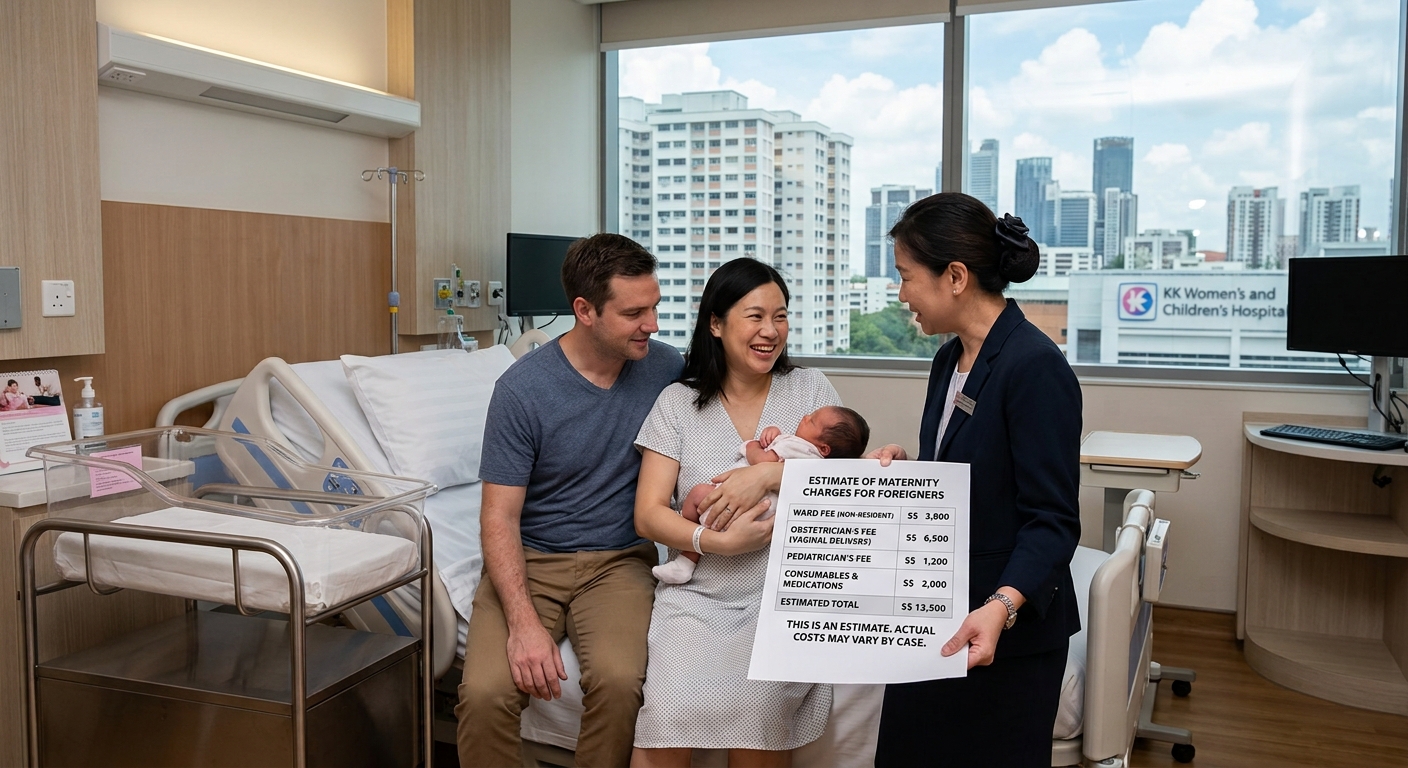
How much can childbirth cost?
This varies enormously depending on:
- public vs private hospital
- ward type
- normal delivery vs Caesarean
- complications
- length of stay
- doctor's fees
- tests and medication
- baby's medical care
- insurance coverage
For context, MOH's current fee information shows a typical subsidised KKH inpatient bill for vaginal delivery in a B2 ward at approximately S$1,486, with a typical range of S$1,243–S$1,898 in the cited dataset.
At Gleneagles Hospital, the cited typical bill for a one-bed private ward is approximately S$13,367, with a typical range of S$11,954–S$14,636. (Ministry of Health)
| Hospital and ward | Typical bill | Typical range |
|---|---|---|
| Subsidised KKH, B2 ward, vaginal delivery | S$1,486 | S$1,243–S$1,898 |
| Gleneagles Hospital, one-bed private ward | S$13,367 | S$11,954–S$14,636 |
These figures are not a quote for your delivery.
A foreigner's actual bill may differ substantially, and private/non-subsidised rates can be very different.
MOH specifically describes its fee benchmarks as reference points rather than guarantees of the actual bill. (Ministry of Health)
One important point about the baby's name
Try to keep the name consistent across every document.
For example:
Birth certificate → embassy record → passport → Dependant's Pass
If the spelling or order of names differs, you may need additional explanations or documentation.
ICA specifically states that a child's passport name must reflect the relevant records in certain immigration processes. (ICA)
So before submitting the birth registration:
Double-check every letter.
What about travelling outside Singapore?
Do not assume that having the Singapore birth certificate means the baby can simply travel.
The birth certificate is not a passport.
The baby needs a valid travel document/passport and appropriate immigration status.
If you plan to travel soon after delivery, also speak to the doctor about whether the mother and baby are medically fit to travel.
KKH advises patients to discuss travel plans with their doctor, particularly after surgery or procedures. (KKH)
What if the parents are not EP or S Pass holders?
The Dependant's Pass route described above applies specifically to eligible EP and S Pass holders.
If the parents hold another type of immigration status, do not assume that the baby automatically qualifies for a DP.
ICA states that parents of a non-Singapore-citizen newborn need to ensure that the child has a valid immigration pass after the initial 42-day Special Pass period.
Depending on the circumstances, this may involve a visit pass, extension of stay or another appropriate immigration arrangement. (ICA)
If you are in this situation, check directly with ICA and the relevant immigration authority rather than relying on another family's experience.
What if the DP application is rejected?
MOM states that if a newborn's Dependant's Pass application is unsuccessful, the parents need to either:
- ensure the baby leaves Singapore before the Special Pass expires, or
- request an extension of stay from ICA.
MOM also states that it will not grant an extension of the Special Pass in that situation, so parents should act promptly. (Ministry of Manpower Singapore)
The 10 things I would put on every parent's checklist
1. Decide the baby's legal name
Do this before birth registration.
2. Register the birth
Complete it through LifeSG within 42 days.
3. Download the digital birth certificate
Don't assume the hospital gives you a physical certificate.
4. Contact your embassy
Start the baby's passport/travel-document process immediately.
5. Keep the ICA advisory note
It contains important information about the baby's initial immigration status.
6. Speak to your employer HR
If you are an eligible EP/S Pass holder, ask HR to start the baby's DP application.
7. Track the 42-day deadline
Put the date in your calendar immediately.
8. Track the passport application separately
The embassy's processing time is outside MOM's control.
9. Check insurance
Confirm exactly what the mother and newborn are covered for.
10. Keep every document
Birth certificate, passport, immigration pass, hospital documents and bills may all be needed later.
The most important lesson
For foreign parents, the birth of a baby in Singapore creates three separate administrative processes:
1. Singapore birth registration
ICA / LifeSG
↓
2. Baby's nationality and passport
Your country's embassy/high commission
↓
3. Baby's legal stay in Singapore
MOM or ICA, depending on the parents' immigration status
These are related, but they are not the same process.
Getting the Singapore birth certificate does not automatically give the baby a Singapore passport.
Getting a foreign passport does not automatically give the baby a Singapore immigration pass.
And submitting a Dependant's Pass application does not mean parents should ignore the baby's existing Special Pass expiry date.
Final checklist for foreign parents
If you remember nothing else, remember these:
Birth → Birth Certificate → Passport → Immigration Pass
And keep track of the 42-day Special Pass period.
Start the passport process early.
Speak to your employer HR early if you are using the Dependant's Pass route.
Keep your embassy, ICA and MOM communications.
And keep copies of every document.
Most importantly, don't wait until Day 35 to discover that your country's embassy needs a document you don't have.
Official sources
Immigration & Checkpoints Authority (ICA)
Birth registration, digital birth certificates and the 42-day Special Pass: ICA — Register Birth and Download Digital Birth Certificate
Ministry of Manpower (MOM)
Newborn Dependant's Pass process: MOM — Getting a Dependant's Pass for a newborn
MOM — Dependant's Pass documents: MOM — Documents required for Dependant's Pass
Ministry of Health (MOH)
Hospital bills and fee benchmarks: MOH — Hospital Bills and Fee Benchmarks
KK Women's and Children's Hospital
Birth registration and discharge information: KKH — Birth Registration
KKH — Hospital bill and payment: KKH — Hospital Bill and Payments
Information checked: September 2026.
Where to verify: This article is general editorial information, not legal, immigration, medical or financial advice. Requirements can change. Check the relevant Singapore government agency or a qualified professional for advice about your situation.