If you are considering moving to Singapore for work, one of the biggest questions is:
“How much do I actually need to earn to live comfortably here?”
The answer depends enormously on your circumstances.
A single professional renting a room can live very differently from a family of four paying for private housing and international school.
Singapore can be relatively manageable if you use public transport, cook regularly and live in an HDB flat or shared accommodation. But the monthly budget changes significantly once you add private housing, restaurants, frequent travel or international school fees.
This guide gives you a practical 2026 salary and cost-of-living framework for foreigners considering a move to Singapore.
⚠️ IMPORTANT DISCLAIMER — PLEASE READ
All salary and monthly-budget figures in this article are estimates for planning purposes only. They are NOT official minimum-income requirements and should not be interpreted as a guarantee that a particular salary will provide a particular lifestyle.
Actual costs vary depending on: where you live, size and type of accommodation, whether you rent a room or an entire property, whether you live alone or share, your children's ages and school, nationality and residency status, how often you eat out, how much you travel, healthcare and insurance arrangements, whether your employer provides housing, schooling, insurance or relocation benefits and your personal spending habits
Housing and school fees in particular can vary by thousands of dollars a month.
Some foreigners and families deliberately reduce costs by sharing accommodation, renting rooms, living further from the city centre, using public transport and choosing mainstream Singapore schools instead of international schools.
The figures below are therefore best viewed as realistic budgeting ranges rather than a definition of what a “comfortable life” must cost.
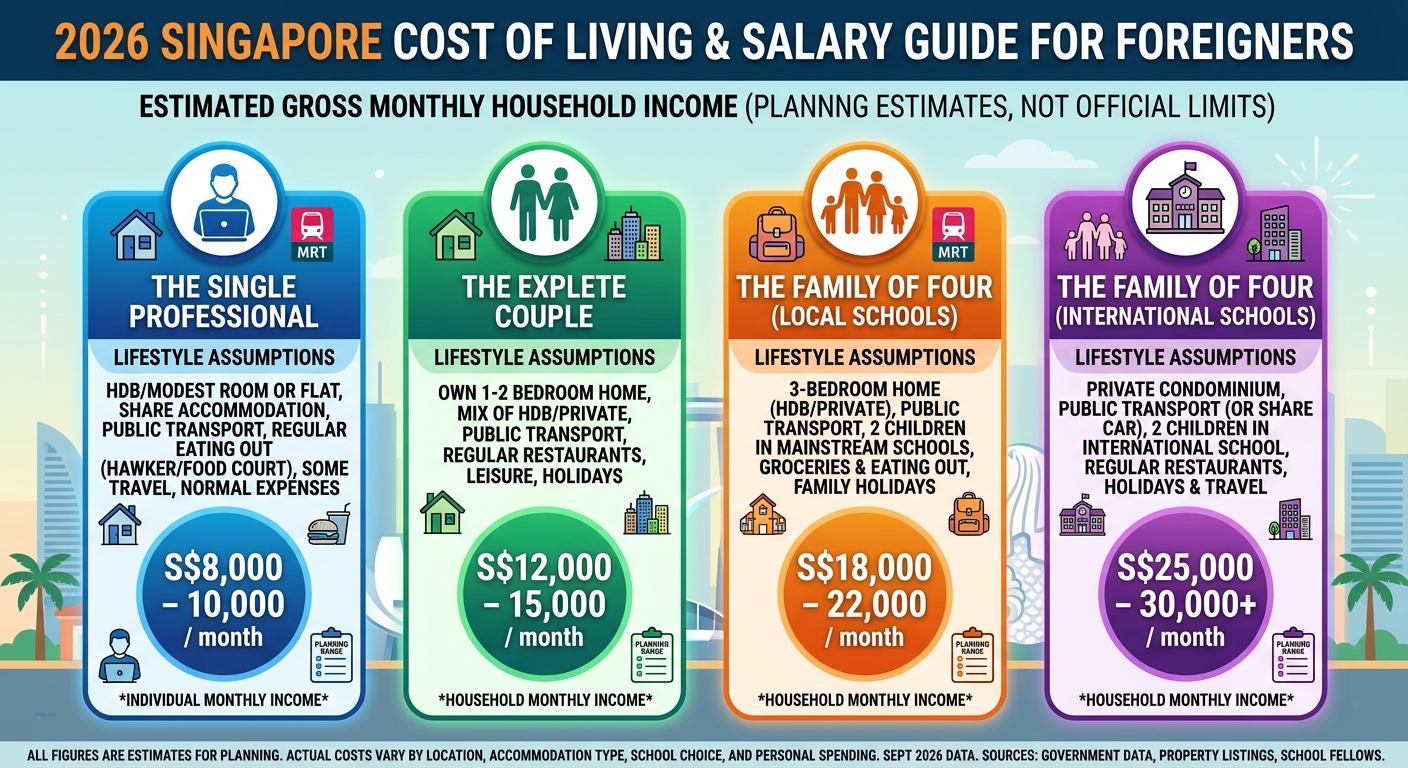
For a foreigner moving to Singapore in 2026, a reasonable starting point for gross monthly household income would be approximately:
| Household | Lifestyle assumed | Estimated gross income to aim for |
|---|---|---|
| Single | Room/HDB or modest private rental, eating out regularly, public transport, some travel | S$8,000–10,000/month |
| Couple | Own 1–2 bedroom home, restaurants, public transport, holidays | S$12,000–15,000/month household |
| Family of 4 – local/mainstream schools | 3-bedroom HDB/private rental, two children in mainstream schools, holidays | S$18,000–22,000/month household |
| Family of 4 – international schools | Private housing, two children in international school, holidays | S$25,000–30,000+/month household |
These are gross household income estimates, not take-home pay.
If only one person is earning, income tax will also affect the amount available to spend. Singapore's resident personal income tax is progressive, with rates ranging from 0% to 24%. Foreigners generally qualify as tax residents when they meet the relevant stay/work conditions. (Default)
1. The biggest expense: housing
For most people moving to Singapore, housing will be the single biggest variable in the budget.
There are broadly three approaches:
- Rent a room/share accommodation
- Rent an HDB flat
- Rent a private condominium/apartment
Can foreigners rent HDB?
Yes.
Foreigners legally residing in Singapore on eligible passes — including Employment Pass, S Pass and Dependent’s Pass — can rent HDB flats or rooms from the open market, subject to HDB's rules and the relevant pass validity requirements. (Housing & Development Board)
However, renting HDB is different from buying HDB.
A foreigner who is not a Singapore Citizen or PR generally cannot simply purchase an HDB flat. For example, HDB's current rules for families require the household to include a Singapore Citizen or Permanent Resident, and an all-PR household must generally have held PR status for at least three years. (Housing & Development Board)
Option 1: Rent a room / share accommodation
This is one of the ways a newcomer can significantly reduce living costs.
Current September 2026 listings show HDB common rooms advertised at around S$780–S$1,500+ per month, depending on location, room type and conditions. (PropertyGuru)
You will also find room-sharing and co-living arrangements.
Indicative budget
S$800–1,500/month for a room
This can make a major difference to the economics of moving to Singapore.
For someone earning S$8,000/month, for example, spending S$1,000 on accommodation is very different from spending S$4,000 on a private apartment.
Important: check the tenancy arrangement carefully and make sure the landlord and rental arrangement comply with the applicable HDB/private-property rules.
Option 2: Rent an HDB flat
For couples and families, an entire HDB flat can offer considerably more space than a private condominium for the same money.
HDB's official Q1 2026 median rental data shows how much rents vary by town and flat size.
For example, Q1 2026 median rents included:
- 4-room HDB in Bedok: S$3,300
- 4-room HDB in Bukit Batok: S$3,200
- 4-room HDB in Bukit Panjang: S$3,000
- 4-room HDB in Bishan: S$3,600
- 4-room HDB in Central Area: S$4,200
- 5-room HDB in Bedok: S$3,650
- 5-room HDB in Bukit Merah: S$4,200 (Housing & Development Board)
Current listings also show 3-bedroom HDB flats around S$3,600–S$4,200+ in several locations. (PropertyGuru)
Practical planning range
Couple: S$2,800–4,000/month
Family: S$3,200–4,500+/month
Location, size, age, renovation, furnishing and proximity to MRT stations can all change the price.
Option 3: Private condominium
Private housing generally costs more, but it can offer facilities such as swimming pools, gyms, security and recreational areas.
Current listings provide a useful indication of the market.
For example, September 2026 listings show:
- 1-bedroom condos from around S$2,900–4,500+
- 2-bedroom condos around S$3,900–5,800+
- 3-bedroom condos around S$3,800–6,600+
Prime locations can be substantially more expensive. (PropertyGuru)
URA's Q1 2026 statistics also show that private residential rents remained elevated, with the overall private residential rental index increasing 0.3% in Q1 2026. (Urban Redevelopment Authority (URA))
Practical planning range
Single: S$3,000–4,500 for a 1-bedroom
Couple: S$4,000–5,500 for a 1–2 bedroom
Family: S$5,000–7,000+ for a 2–3 bedroom
2. What does food cost?
Singapore gives you an unusual range of choices.
You can eat relatively affordably at:
- hawker centres
- food courts
- coffee shops
Or you can spend considerably more at:
- restaurants
- cafes
- international restaurants
- premium dining
Singapore's Household Expenditure Survey found that resident households spent an average of S$1,422 per month on food in 2023.
Within that:
- about S$491 was spent at hawker centres, food courts and coffee shops
- about S$403 was spent at restaurants, cafes and pubs
- about S$456 was spent on food and non-alcoholic beverages. (Singapore Department of Statistics)
This is a useful official benchmark, although remember that resident household averages are not the same thing as an expatriate household budget.
Practical planning estimate
Single: S$700–1,200/month
Couple: S$1,200–1,800/month
Family of 4: S$1,600–2,500+/month
If you cook regularly and eat at hawker centres, you can spend less.
If you eat at restaurants several times a week, the number can rise quickly.
3. Eating out and restaurants
One of Singapore's advantages is that eating out does not automatically mean expensive restaurant dining.
A person can have relatively inexpensive meals at hawker centres and food courts, while a restaurant meal can cost considerably more.
This creates a large lifestyle difference between two people earning exactly the same salary.
Example
Someone earning S$8,000 but eating mostly at hawker centres and cooking at home could potentially save significantly more than someone earning S$10,000 who frequently eats at restaurants.
Food is therefore one area where lifestyle has a very significant impact on the required salary.
4. Getting to work: public transport
This is one area where Singapore can be relatively manageable.
The public transport system includes MRT and buses, with fares based on distance.
As of 2026, adult monthly unlimited travel passes for basic bus and train services cost S$122. Standard card fares for many bus/train journeys are considerably lower on a per-trip basis. (Public Transport Council)
Planning estimate
For a working adult using MRT/bus regularly:
S$100–200/month per person
A couple commuting regularly might therefore spend around:
S$200–400/month
A family using public transport rather than owning a car can keep transport costs substantially lower.
5. What about owning a car?
This is where the budget can change dramatically.
Singapore's car ownership system involves the Certificate of Entitlement (COE), along with vehicle purchase, taxes, insurance, fuel, parking and maintenance.
For someone evaluating a Singapore job, I would not automatically include a car in the minimum salary calculation.
Public transport is extensive enough that many people choose not to own a car.
The Singapore Department of Statistics also shows that transport expenditure is significantly higher among households with private road transport than public transport users. In 2023, married couples with young children spent an average of S$1,499 per month on transport, including about S$1,129 on private road transport. (Singapore Department of Statistics)
6. Schooling: this can completely change the family budget
For families, education is probably the second major variable after housing.
There are several routes.
Option A: Singapore mainstream schools
Government and government-aided schools can be considerably cheaper than international schools.
But foreign students pay different fees from Singapore Citizens and PRs.
For 2026, an example government primary school lists:
| Student | Monthly school fee + miscellaneous fee |
|---|---|
| Singapore Citizen | S$13 |
| Singapore PR | S$318 |
| ASEAN international student | S$583 |
| Non-ASEAN international student | S$998 |
At secondary level, 2026 fees are higher.
One MOE secondary school lists:
| Student | Monthly total |
|---|---|
| Singapore Citizen | S$25 |
| Singapore PR | S$700 |
| ASEAN international student | S$1,111.80 |
| Non-ASEAN international student | S$2,211.80 |
So a family with two non-ASEAN foreign children could potentially face several thousand dollars a month in mainstream-school fees depending on the children's ages.
There can also be costs for: uniforms, books, transport, activities, examinations, enrichment, school-specific programmes
7. Independent schools
Independent schools can be considerably more expensive than standard government schools.
For example, Hwa Chong Institution's published 2026 fees for international students are:
- S$1,500/month for ASEAN students in Secondary 1–2
- S$2,600/month for non-ASEAN students in Secondary 1–2
Higher levels can cost more. (Hwa Chong Institution)
Raffles Institution's 2026 fees similarly vary by nationality and year level, with non-ASEAN international students paying over S$3,000 per month at some levels. (Raffles Institution)
So families should not assume that "local school" automatically means a very low education budget.
8. International schools
This is where the budget can increase dramatically.
International schools typically charge annual tuition rather than the relatively modest monthly fees associated with mainstream government schools.
For example, UWCSEA's published 2026/27 fees show annual tuition of approximately:
- S$39,069 for K1–G1
- S$40,743 for G2–G5
- S$46,866 for G6–G8
- S$47,313 for G9–G10
- S$49,926 for G11–G12
There is also a development levy, with the first-year total therefore higher. (UWCSEA Flipbooks)
ISS International School, for example, publishes 2026/27 annual course fees of around S$27,748 for its primary programme before considering every possible additional cost. (ISS International School)
The important point is:
International school can easily add tens of thousands of dollars per child per year.
For two children, that can become one of the largest items in the household budget.
9. So how much does a family really need?
Let's put the pieces together.
Scenario 1: Single professional
Imagine:
- HDB room/shared accommodation
- public transport
- mix of cooking and eating out
- occasional restaurants
- gym/leisure
- occasional regional travel
- normal phone/utilities/personal expenses
A reasonable planning budget might look like:
| Expense | Monthly estimate |
|---|---|
| Room/shared accommodation | S$800–1,500 |
| Food | S$700–1,200 |
| Transport | S$120–200 |
| Utilities/phone/internet | S$150–250 |
| Healthcare/insurance/personal | S$150–300 |
| Restaurants/leisure | S$400–700 |
| Travel/holidays fund | S$300–500 |
| Miscellaneous | S$300–500 |
| Estimated total | S$2,920–5,150 |
Salary to aim for
S$8,000–10,000 gross/month
This gives a single professional considerably more room than simply earning the minimum required to survive.
If you want your own private apartment rather than a room, I would budget more.
Scenario 2: Couple without children
Assume:
- own 1–2 bedroom HDB/private rental
- public transport
- regular restaurant meals
- groceries
- entertainment
- occasional regional travel
| Expense | Monthly estimate |
|---|---|
| Housing | S$3,000–5,000 |
| Food & groceries | S$1,200–1,800 |
| Transport | S$200–400 |
| Utilities/communications | S$250–400 |
| Healthcare/insurance | S$250–500 |
| Restaurants/leisure | S$500–900 |
| Travel fund | S$400–700 |
| Miscellaneous | S$400–600 |
| Estimated total | S$6,200–10,300 |
Salary to aim for
S$12,000–15,000 household gross/month
A couple earning substantially less can certainly live in Singapore, particularly with shared housing, a more affordable HDB rental and controlled discretionary spending.
Scenario 3: Family of four — mainstream schools
Now imagine:
- two adults
- two school-going children
- 3-bedroom HDB/private rental
- mainstream Singapore schools
- public transport
- groceries plus regular eating out
- some holidays
A planning budget could look like:
| Expense | Monthly estimate |
|---|---|
| 3-bedroom housing | S$3,500–5,000 |
| Food/groceries/eating out | S$1,800–2,500 |
| School fees | S$2,000–4,500+ |
| Transport | S$300–500 |
| Utilities/communications | S$300–450 |
| Healthcare/insurance | S$400–700 |
| Leisure/activities | S$500–900 |
| Travel/holiday fund | S$500–800 |
| Miscellaneous | S$500–800 |
| Estimated total | S$9,800–16,150+ |
The school component can vary enormously depending on the children's nationality and whether they attend mainstream, independent or international schools.
Salary to aim for
Around S$18,000–22,000 gross household income/month
This is a planning range rather than an official threshold.
Scenario 4: Family of four — international schools
This is a completely different financial proposition.
Imagine:
- private condominium
- two children
- international school
- public transport
- regular restaurants
- regional/international holidays
A rough planning framework might be:
| Expense | Monthly estimate |
|---|---|
| Private housing | S$5,000–7,000+ |
| Food/groceries/restaurants | S$2,000–2,800 |
| International school – two children | S$6,500–9,000+ |
| Transport | S$300–500 |
| Utilities/communications | S$350–500 |
| Healthcare/insurance | S$500–800 |
| Leisure/activities | S$700–1,000 |
| Travel fund | S$500–1,000 |
| Miscellaneous | S$600–900 |
| Estimated total | S$16,450–23,500+ |
International school fees alone can exceed S$40,000 per child annually at some schools. UWCSEA's published 2026/27 fees demonstrate how quickly the education budget can rise. (UWCSEA Flipbooks)
Salary to aim for
S$25,000–30,000+ gross household income/month
Again, this is a planning estimate.
A family can live on less by choosing HDB housing, mainstream schooling and a more modest lifestyle. Conversely, a family choosing premium housing, international schools, frequent travel and a car could require considerably more.
10. Don't forget income tax
When looking at a Singapore salary, don't simply compare the gross salary with your expected expenses.
Singapore's resident personal income tax is progressive.
For YA2024 onwards, for example:
- first S$20,000: 0%
- next S$10,000: 2%
- next S$10,000: 3.5%
- next S$40,000: 7%
- next S$40,000: 11.5%
- next S$40,000: 15%
- next S$40,000: 18%
- higher income is taxed progressively up to 24%. (Default)
A foreigner who qualifies as a Singapore tax resident is taxed at these progressive rates, subject to the applicable rules and reliefs. (Default)
Illustrative example
A gross annual salary of S$96,000 works out to S$8,000/month.
Using the resident tax rates and ignoring personal reliefs, the annual tax would be approximately S$5,190, leaving approximately S$90,810 after income tax, or about S$7,568/month before considering any other deductions.
This is only an illustration — your actual tax position can differ.
11. Holidays and travel
This is another area where two families with identical salaries can have completely different lifestyles.
Singapore is well connected to Asia, so travelling to destinations such as Malaysia, Thailand, Indonesia, Vietnam, Japan and other regional destinations can be an attractive part of the lifestyle.
But "how much you need for holidays" is impossible to define without knowing: number of trips, number of travelers, destination, hotel standard, school holiday periods, flights, activities
Singapore's official Household Expenditure Survey provides a useful historical benchmark: resident households spent an average of S$139 per month on package holidays and S$93 on passenger air transport in 2023. (Singapore Department of Statistics)
For someone moving to Singapore as an expatriate, however, I would treat travel as a separate personal budget rather than assume the national average applies.
12. Healthcare and insurance
Healthcare is another expense that newcomers should not ignore.
Singapore has both public and private healthcare systems.
The Ministry of Health publishes hospital bill information and fee benchmarks to help patients understand the costs of treatment in public and private settings. (Ministry of Health)
Your employer may provide medical insurance, but the coverage varies considerably between employers.
Before accepting a Singapore job, check:
- employee medical coverage
- spouse coverage
- children's coverage
- outpatient coverage
- hospitalization coverage
- maternity coverage
- dental coverage
- annual limits
- panel hospitals/clinics
- whether dependents are covered
Employer benefits can therefore materially change the salary you actually need.
13. What about sharing?
This deserves special mention because sharing is a real part of the Singapore rental market.
For a single person, renting a room instead of an entire apartment can reduce housing costs substantially. Current HDB listings show many rooms around the S$800–S$1,500 range, although prices vary by location and room type.
Some couples or families also make compromises on location or housing size rather than paying for a centrally located private property.
This is why saying:
"You need S$10,000 to live in Singapore"
without explaining the lifestyle behind that number can be misleading.
Someone earning S$7,000 and renting a room near an MRT station may have a very different monthly budget from someone earning S$12,000 and renting a private condominium.
14. The salary number I would use when evaluating a Singapore job
If you are currently overseas and considering whether a Singapore job offer is financially attractive, I would think about the offer in three layers.
🟢 S$8,000–10,000/month
Generally workable for a single professional, particularly with room/HDB/shared accommodation and public transport.
🟡 S$12,000–15,000/month household
A reasonable range for a couple, particularly if housing and lifestyle are managed carefully.
🟠 S$18,000–22,000/month household
A useful target for a family with children in mainstream/local education, depending heavily on housing and school choices.
🔵 S$25,000–30,000+/month household
A more realistic range for a family choosing private housing and international schooling, especially with two children.
These should not be interpreted as official salary requirements. They are practical budgeting ranges derived from current housing, school, transport and household-spending information.
15. One final thing: salary isn't the whole package
When comparing a Singapore job offer with your current salary overseas, don't look only at the headline number.
Ask what the employer provides.
A package that includes:
- medical insurance
- family medical coverage
- relocation assistance
- temporary accommodation
- school allowance
- housing allowance
- annual bonus
- flights/home leave
- transport allowance
can have a very different financial value from a job offering the same basic salary with none of these benefits.
For families especially, schooling and housing allowances can make a very significant difference.
Sources used
- Singapore Department of Statistics — Household Expenditure Survey (Singapore Department of Statistics)
- HDB — Rental eligibility and HDB rental information (Housing & Development Board)
- HDB — Q1 2026 median HDB rents by town and flat type (Housing & Development Board)
- URA — Q1 2026 private residential rental statistics (Urban Redevelopment Authority (URA))
- PropertyGuru — current September 2026 HDB and private-property rental listings (PropertyGuru)
- Public Transport Council — 2026 public transport fares (Public Transport Council)
- IRAS — Singapore individual income-tax rates and tax residency (Default)
- Ministry of Education school fee information published by MOE schools for 2026 (Gongshang Primary School)
- UWCSEA — 2026/27 international-school fees (UWCSEA Flipbooks)
- ISS International School — 2026/27 fees (ISS International School)
- Ministry of Health — hospital bills and fee benchmarks (Ministry of Health)
Information checked for this article: September 2026.
Where to verify: This article is general editorial information, not legal, immigration, medical or financial advice. Requirements can change. Check the relevant Singapore government agency or a qualified professional for advice about your situation.