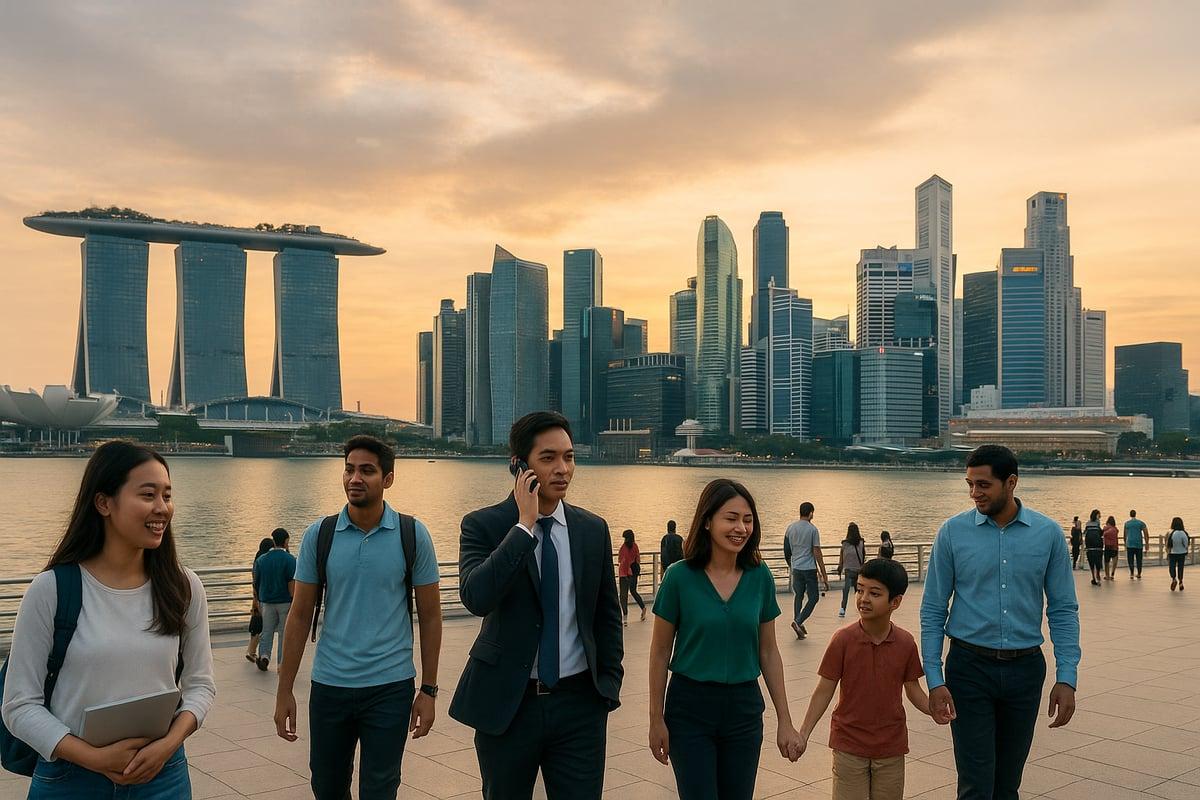
Singapore is one of the world’s wealthiest economies, admired for its safety, efficient public services, excellent infrastructure and global opportunities. Yet, a recent conversation involving former Foreign Affairs Minister George Yeo raises an important question: Can economic success translate into happiness?
Speaking on Bloomberg’s The Mishal Husain Show, in an episode recorded in Singapore and released in September 2026, Yeo recalled advice he said he had received from founding Prime Minister Lee Kuan Yew: “Never promise happiness.”
The remark highlights a simple truth: governments can create opportunities and improve living standards, but happiness is deeply personal.
What did George Yeo mean?
Yeo explained that governments can work towards economic growth, better infrastructure and quality education, but happiness is harder to guarantee.
Reflecting on his time at the Ministry of Trade and Industry and the Ministry of Foreign Affairs, he recalled that despite demanding workloads, morale was high. He also suggested that some discomfort can accompany achievement.
His point was not that people should be unhappy, but that ambition and progress often require effort and sacrifice. The question is how to balance these demands with personal well-being.
Where does Singapore rank on the World Happiness Report?
According to the 2026 World Happiness Report, Singapore ranked 36th out of 147 countries, with a life-evaluation score of 6.585 out of 10. Finland topped the ranking.
- Global ranking: 36th out of 147 countries
- Life-evaluation score: 6.585/10
- Survey period: 2023–2025
The report measures how people evaluate their lives, rather than how cheerful they feel each day. Singapore’s ranking offers one perspective on well-being, but does not define the happiness of its people.
Why might people in Singapore feel under pressure?
1. Cost of living and financial anxiety
A 2025 Cigna Healthcare study found that 79% of Singapore respondents experienced stress. Key concerns included the cost of living (53%), uncertainty about the future (47%) and personal finances (43%).
Even in a prosperous society, providing for a family, planning for retirement and managing daily expenses can remain significant concerns.
2. Workplace pressure and the pursuit of success
Singapore’s competitive economy offers valuable opportunities, but demanding work schedules and high expectations can create pressure.
Gallup’s 2026 workplace report found that 43% of Singapore employees experienced substantial stress the previous day, while 14% were engaged at work.
These findings remind us that professional success and financial security do not always translate into personal fulfilment.
3. Social connections and belonging
The World Happiness Report identifies social support — having someone to count on — as an important factor in life evaluations.
Amid busy schedules and family responsibilities, making time for meaningful relationships can be challenging. Strong connections with family, friends and the wider community remain essential to a fulfilling life.
4. Global success and local identity
Singapore’s international standing attracts businesses and talent from around the world. This brings opportunities, while also making social cohesion and a sense of belonging important considerations.
Yeo has highlighted the need to address social divisions between Singaporeans and wealthier foreign residents. The conversation need not be about choosing one group over another, but about ensuring that growth remains inclusive and Singaporeans continue to feel valued in their own home.
5. The culture of hard work
Singaporeans’ determination and adaptability have helped build the nation’s success. The country’s infrastructure, safety, education and strategic location also make it attractive to global businesses and professionals.
However, competition and changing workplace expectations can leave some workers feeling the need to continually prove their worth and keep pace.
The challenge is to preserve Singapore’s drive for excellence while ensuring that people have opportunities to develop their skills, feel secure in their careers and maintain a healthy balance between work and family life.
Can prosperity and happiness go hand in hand?
Singapore’s experience shows that prosperity and happiness are closely related, but they are not interchangeable.
Economic growth provides a strong foundation through better infrastructure, education, healthcare and employment opportunities. Yet, a fulfilling life also depends on time with loved ones, meaningful relationships, financial security and a sense of purpose.
No government can guarantee happiness. But thoughtful policies, supportive workplaces and strong communities can help create conditions in which people are better able to thrive.
The goal is not to choose between economic ambition and personal well-being. It is to ensure that Singapore continues to excel while giving its people greater opportunities to enjoy the lives they work so hard to build.
As Singapore navigates an increasingly challenging global economic environment, the road ahead will require resilience, adaptability and a shared sense of purpose. Just as important is the spirit of community — standing by one another, showing kindness and offering support when times are difficult. After all, a stronger Singapore is built not only through collective effort, but also through the care and understanding we extend to one another.
Sources and further reading
- Mothership — George Yeo on wealth, unhappiness and achievement
- World Happiness Report 2026 — official report
- Gallup — Singapore workplace and well-being data
- Cigna Healthcare — Financial stress and well-being in Singapore